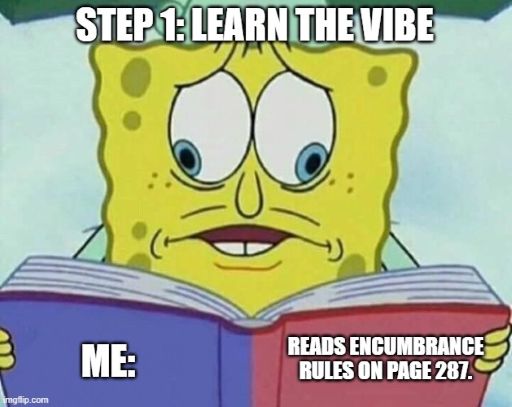
I bet a lot of RPG books have never made it to the table. They sit there on the shelf like beautiful, unread bricks. The common mistake I think is treating them like novels.
Most RPG books are not written to be read cover to cover like a page-turning thriller. They’re technical manuals wearing a nice hat. If you approach them like you’re settling in with a good book, no wonder your brain quietly climbs out your ear and leaves.
This is about reading rulebooks practically , so you can get to the table faster, with enough understanding not to panic when someone asks, “So how do I actually roll to hit?”
Let’s walk through the process I use that treats the book as a toolbox, not scripture. That way we can get them to the table and use them as they have mostly been intended.
1. Stop Reading Rulebooks Like Novels
The first mental shift I will advocate is that you are not primarily reading for entertainment, you’re reading for function.
Your goals are:
- Understand what the game is about (vibe, theme, expected play)
- Grasp how you physically interact with it at the table (mechanics, procedure)
- Know where to find things when (not if) you forget them mid-session
That means:
- You do not need to read everything in order.
- You do not need to memorise every rule.
- You do not need to understand all 400 pages before Session Zero.
Experienced GMs often skim, build a character, and then go back through the rules with that character in mind.
Others “play the rules as they read”., literally running fake encounters or scenes to make the mechanics stick.
Few of them are sitting there highlight-annotating page 327 of the vehicle chase modifiers section for fun.
So, my advice is to stop trying to “finish the book.” Start trying to use it.
2. First Pass: Get the Vibe
Before you care how to roll dice, you need to know what sort of story the game is trying to tell (or what kind of experience it is trying to facilitate).
On your first pass, you’re looking for:
- The intro / “What is this game?” section
- Any short example of play
- Sidebars about tone, themes, or intended genre
- Those little designer notes that explain “why we did it this way”
Ask yourself:
- Is this heroic, grim, goofy, tragic, pulpy, investigative…?
- Are characters expected to win, struggle, or die horribly but meaningfully?
- Does the game seem to care more about combat, social drama, heists, mystery, or feelings and trauma in the rain?
Think of it like reading the blurb and first chapter before committing. You’re not learning rules yet. You’re figuring out what kind of behaviour the game is trying to produce at the table.
If the vibe doesn’t excite you, that’s useful data. Better to discover that on page 10 than after printing 50 pages of handouts.
3. Find the Core Mechanics (The “How Do I Do Anything?” Bit)
Nearly every game has a core loop:
“When you try to do something risky, roll X vs Y. On success, this happens; on failure, that happens.”
Your job is to dig that out early.
Look for:
- The basic resolution mechanic (roll + stat vs DC, dice pool vs target, cards, Jenga tower, etc.)
- How advantage/disadvantage / bonuses / penalties work
- What happens on:
- Success
- Failure
- Mixed/partial success (if it’s that kind of game)
Some writers put this early (good). Some hide it halfway down a column on page 47 because layout is a joke (less good). If finding it feels like a puzzle, welcome to tabletop RPGs.
Once you’ve found the core mechanic, don’t just nod and move on. Test it.
- Pick a simple action: “I pick the lock.”
- Work through: what do I roll? What’s the target? What happens on failure?
- Now try something else: “I shoot the cultist,” “I sweet-talk the guard,” “I leap across the chasm.”
You’re trying to see how the system wants you to think. Some designers even talk about rules as a proposition: once you accept the core mechanic, the rest of the book is the argument built on top of it.
4. Work Through Character Creation (Properly)
The fastest way to understand a system is to build a character (or three).
Most experienced folks do this very early in the process: skim the book, then dive into character creation, then go back and fill in gaps.
Why it helps:
- You see what the game expects characters to do (lots of combat options? social moves? magic trees?)
- You learn what the stats and skills actually mean in practice
- You get a feel for power level. Are you scrappy mortals or demigods?
When you do this:
- Follow the step-by-step guide in the book.
- Look up every rule it references (or at least mark them for later).
- Pay attention to:
- What choices feel important (class, playbook, archetype, career, heritage, etc.)
- What looks like mere colour
- Where you get decision paralysis (always a sign of either good design or far too many feats)
If you’re GMing, build:
- One “typical” PC for your campaign concept
- One slightly weird edge case (“what if someone goes full glass cannon wizard?”)
- Maybe a simple NPC or two if the game has quick-build rules for them
You’re not just learning the rules, you’re learning what the game wants on the character sheet.
5. Imagine a Few Key In-Play Situations
Now, instead of reading more, play in your head.
Take three or four situations you know will come up in your campaign:
- A tense social scene: interrogation, negotiation, or begging the Duke not to hang you
- A physical challenge: chase, climb, break-in, or desperate escape
- A fight: a small one, not your big boss encounter
- Something on-brand for the game: spellcasting, hacking, heists, spaceship crashes, unraveling forbidden tomes, etc.
For each one:
- Ask: “What do the players say they’re doing?”
- Ask: “What does the book say I do now?”
- Trace the steps: what do they roll, what numbers do I care about, what are the outcomes?
You’re looking for answers to questions like:
- Does this game have structured combat rounds, or is it narrative?
- How does it handle group actions?
- Are there fail-forward / partial success mechanics or just “succeed/fail and cry”?
- How lethal does a basic exchange look?
People often say the best way to learn is to “play the rules as you read them”. Actually run these little mock scenes to cement the procedures in your head.
If you can’t work out how a common situation is meant to flow, mark it with a sticky note. Either you’ve missed a section, or the book hasn’t explained itself properly (both happen).
6. Skim the Inventory: Skills, Gear, Spells, Abilities, etc.
This is the bit that kills people who try to read linearly. You get to “Chapter 6: Every Possible Sword” and your soul leaves your body.
Don’t read it all. Skim it with intent.
You’re trying to answer:
- What kinds of things exist in this world? (Tech, magic, psychic powers, weird pets…)
- How complicated is this stuff? (Lots of tags and subsystems, or fairly simple bonuses?)
- Are there any obvious traps or must-take options you should flag for your players?
Skim approach:
- Look at the categories and headings, not every line of the tables.
- Read a few representative entries: a basic weapon, a mid-tier spell, a typical skill.
- Note anything that makes you go, “Wait, how does that work?” and find the rule for that, rather than reading all 200 spells.
Think like a chef glancing through a pantry, not like a food historian cataloguing every grain of rice.
7. Make Notes, Cheat Sheets, and Bookmarks
You will not remember everything. You are not meant to remember everything. That is why the book exists.
Do, however, remember where things are. That’s what notes are for.
Helpful habits I have developed:
- Keep a single page (or digital doc) for:
- Core mechanic
- Turn/round structure
- Typical difficulty levels / modifiers
- Damage / consequences flow
- Jot page numbers for:
- Character creation
- Conditions / status effects
- Magic / powers lookup
- GM advice section
Many GMs swear by writing their own cheat sheet / GM screen for a new system. The act of summarising rules forces them to really learn them. You don’t need to make it pretty; you just need to be able to glance at it mid-session.
And for physical books: sticky tabs. So many sticky tabs. Embrace the porcupine aesthetic.
8. Ask the Book Questions (On Purpose)
Most people passively soak up text and then wonder why nothing stuck. Instead, interrogate the book.
As you read, keep asking:
- “How would I actually run this at the table?”
- “What problem is this rule solving?”
- “Where would this ever come up?”
- “Do I care about this for my campaign?”
If the answer to that last question is “no,” feel free to skim. A common piece of advice is: start reading more or less linearly, but skip aggressively and reference back when you actually need something.
You’re not studying for an exam. You are shopping for tools.
9. You Absolutely Do Not Need to Know It All
Let’s be real: very few people have read every word of their favourite 300-page rulebook, let alone remember it.
It is completely fine to start running the game having only read:
- The intro & vibe
- Core mechanics
- Character creation
- Basic conflict rules (combat / social / investigation / whatever the game focuses on)
Hand-wave or simplify obscure subsystems for the first few sessions. Look things up at the table. Say, “I don’t know, let’s rule it this way now and I’ll check later.”
You don’t need mastery before you start. The key is to get playing and learn the details in motion.
What you shouldn’t do is pretend to expertise you don’t have and then dig your heels in when you’re wrong. “We’ll fix it next time” is one of the healthiest phrases in GMing.
10. Working Out “Just Enough to Get Playing”
So what is “just enough”?
Here’s a decent minimum checklist before Session Zero / One:
- Know the elevator pitch of the game
- Understand the core resolution mechanic and when to use it
- Be able to walk players through character creation (or provide pregens)
- Have a handle on:
- How to run a scene (who talks, when you roll, how to narrate results)
- How to run a basic conflict (fight/chase/social, as appropriate)
- Have a bookmark / note for:
- Damage / harm / consequences
- Recovering / resting / healing
- Levelling up or advancement (even if you won’t use it immediately)
You do not need:
- Deep knowledge of every class, spell list, or edge case rule
- Total recall of setting canon
- To have read every GM advice sidebar
If something falls outside your “just enough” bubble during play, do one of three things:
- Quick lookup if it’s central and you know where it is.
- Quick ruling (“We’ll treat it like X for now”) if it’s minor.
- Defer it (“That’s cool, let’s say it works roughly like this and I’ll read the exact rule later.”)
You’re managing pacing at the table, not performing for a judging panel.
11. Use External Brains (Videos, APs, Blogs)
You are not alone. You live in the age of people filming themselves playing pretend on the internet.
Useful external help:
- Actual Plays / streamed games. Seeing the system in motion really helps if the text is dense.
- Short YouTube rules overviews. Great for getting the core loop into your head quickly.
- Blog posts and forum threads: “how I read this book” or “things I wish I’d known before running X” often contain gold.
Use these after your first skim, not before. Otherwise you end up absorbing someone else’s interpretation with no sense of what’s actually in the book.
Think of it as asking a friend who’s already fallen down this rules pit to show you the handholds on the way back up.
12. Final Thoughts: You’re Learning a Game, Not Passing a Test
The point of all this is simple:
- Treat the book as a tool, not a sacred text.
- Read for use, not for completion.
- Get to the table as soon as you’ve got “just enough.”
- Let play finish teaching you what the book started.
If you end up house-ruling half the game because you never quite read Chapter 9: Advanced Grappling on Fire, that’s fine. If everyone’s having fun and the dice are hitting the table, you’re doing it right.
Next time you pick up a shiny new RPG, don’t ask, “Can I read all of this?”
Ask, “What’s the minimum I need from this book to run something cool next week?”
The rest you can learn the fun way: when your players do something ridiculous and you discover the rule exists, somewhere, in a paragraph you definitely meant to read.
Comments
2 responses to “How to Actually Read TTRPG Rulebooks”
Excellent advice and very similar to when I first read how to *gut andacademic book* – (write three sentences at each stage, be willing to stop at any point)
Read the abstract, Y/N decision.
Read the opening page of the Introduction chsoert. Y/N decision.
Read the opening page of the conclusion chapter and the last page of the book. Y/N decision.
Read the contents, choose most interesting ones, read first page and last page of each chosen chapter. Decide Y/N for each chapter.
If necessary read the chapters you marked as worthwhile.
Stop at any point.
Often you can gut a book well enough to understand it in any time from 10 minutes to 2 hours.
This would work well with your notes above.
Yes, agreed!