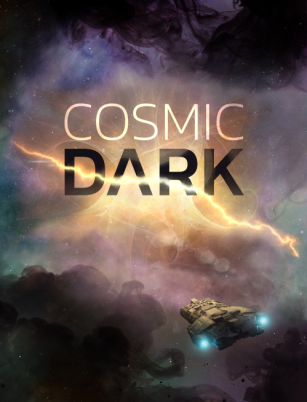
The phrase “cosmic horror in space” covers a multitude of sins and a fair number of excellent games. What makes Cosmic Dark interesting is not just the corporate-hellmouth vibe, but how confidently it structures that vibe into something you can run tonight. The book opens like a briefing from a smiling HR ghoul: you’re Employees of Extracsa, ferried toward a region dominated by a golden tear in reality called the Glitch; you’ll start on a phosphorescent asteroid that is very probably alive; and the rules will reveal themselves as the horror does. It’s lean, eerie, and deliberate.
It also arrives in a post-Mothership/post-Alien moment when we’re spoiled for “work sucks, space worse” RPGs. Cosmic Dark doesn’t compete on gun catalogues or deck plans. It aims for something tighter: investigative procedures that escalate into anomalies on cue, a creeping personal corruption track, and a campaign-in-a-box framed as six “assignments” that stitch into a single, aptly namedm Golden Thread. It reads like a limited series, not an endless syndication.
How the Rules Actually Work
Core play is “learn-by-doing.” The first assignment (“Extraction”) teaches everything: flash back to your crew’s childhood on a backwater world to tie relationships together; descend to the violet, rubber-crystalline asteroid; follow corporate “Operational Instructions”; and then keep asking questions until the place answers back. Resolution is a three-die investigative roll: Reality (you’re doing something that should be possible), Specialism (your job helps), and Changed (you push yourself) each contribute a d6. Take the highest: 1 is bare minimum, 4 is everything you could reasonably know, 5 gives you an in-world Record from Extracsa’s systems, and 6 also triggers an Anomaly, the first shiver of the impossible. You can reroll once, but only if you add your Changed die, inviting trouble. It’s clean and fast at the table.
That Changed die is the personal horror dial. You begin at Changed 1. Whenever something hits body or mind (injury, time-slur, reality-rash) you make a Changed roll; beat your current rating and it ticks up. Reach 6 and you’re done: broken, consumed, written out. It’s a simple, nasty ladder that rewards curiosity the way cliffs reward jumpers. The text repeatedly encourages players to call for their own Changed rolls when something creepy touches them; it’s consent to escalate.
When you spike a 5 or 6, the GM hands you Records (logs, memos, prior incidents) and Anomalies (the “oh no” beats). Those aren’t abstract; each assignment carries bespoke lists to slot straight into play. “Extraction,” for example, goes from mineral scans to human DNA in the rock, then to time dilation and “the rock is trying to heal your wound by encrusting it.” The way it’s written makes the revelation cadence almost automatic, even for a tired brain on a Friday.
Behind the assignments there’s a blunt, practical GM chapter: Mapping the Horror (useful campaign advice), how to make scenes weirder/dangerous/deadly, countdowns and injuries, how to cut away and change the energy, reminders that reality is optional and you can cheat timing to keep momentum. Two rules I love because they state the thesis out loud: “They can’t solve the horror” and “They can’t derail the story.” This is a guided ghost train with clever junctions, not a sim.
What You Actually Do
The six core assignments take you from the living asteroid through memory-haunted corporate mysteries (“Time Murder”), into vast techno-organic structures and mind-bending corporate arcologies (“Transparency”), through paired day/night realities (“Every Sunrise / Every Sunset”), and finally onto the Invisible Hand, a generation ship with golden moss, biomes, and revelations about what humanity will sacrifice to keep the lights on. Each is structured the same way: Approach, Psych Assessment questions to tailor the horror, Operational Instructions, then a curated lattice of locations, Records, and Anomalies. So you’re never guessing how to run the next beat. It feels like investigative OSR with a dramaturg.
The stretch goals book adds one-shots and micro-campaigns from guest writers. Kieron Gillen’s “Umbilical” is a standout: the refinery has blossomed into a baroque womb, the crew are distended choristers exuding subsonic lullabies, and in the resin-fist “crib” a deeply alien child sleeps while the text whispers: “To be a parent is to sacrifice.” It’s alarming, tender, and horribly playable. If a player says “I breathe the atmosphere,” the scenario wants that to be true… for a while.
How It Plays
We make Employees: a mining engineer, medic, team lead, and comms. We flash back to a dusty schoolyard, a recruitment centre, a last look at home; someone admits what scares them most about being alone. We step onto C-151 and the ground flexes like skin. The living pod assembles. The comms ping: “You’ve been gone several hours,” which is odd because we just arrived. The medic tries to pull a shard out of a leg wound and discovers the rock is healing it. Records imply Extracsa knew. Anomalies make the map breathe. Changed ticks up. At some point, someone jokes that the HR form for “encrustation incident” must be exhaustive. Later, no one laughs.
Between assignments you actually get breathers, procedures for “Between Assignments,” home-world interludes, and how to stitch revelations into the larger mystery without a corkboard. It’s brisk: you’re back on the next shuttle before anyone can grow a moustache and a side plot.
What It’s Trying to Do
The design wants: fiction-first investigation, player-led escalation, and curated horror crescendos that end. It’s openly anti-grind. The Psych Assessment questions are there so the horror can echo something the players said in safety, not because Extracsa cares about your feelings. The assignments are modular, but the “Golden Thread” through-line ensures the campaign has spine and catharsis. It’s also keen on honesty: the GM advice cheerfully tells you to make it weird, cut scenes, keep three things happening, and then end before the wine runs out.
Comparisons: why this and not something else?
If your baseline is Mothership, the axis is obvious. Mothership is a crunchy-ish percentile survival-horror toolkit: build a ship, track stress, panic, ammo, and then let TOMBS (Transgression–Omens–Manifestation–Banishment–Slumber) guide you to your bespoke nightmare. It’s brilliant at “blue-collar in the meat grinder,” and the Warden tools are deep. But it assumes you want to assemble your own scenarios from prompts and tables, and it makes gear, skills, and resource management part of the tension.
Cosmic Dark strips almost all of that: no skill points to audit, no weapon lists to tempt, no panic tables; instead you get a three-die investigation ladder, a single corruption track, and six cinematic missions with preloaded Records/Anomalies and very specific tone. Less build, more play; less salvage, more story.
Against ALIEN RPG, the contrast is meta. Alien excels at stress/panic escalation and “cinematic vs. campaign” modes, with crunchy weapons, signature items, and tactical fight moments. It can absolutely do investigative dread, but the tension often resolves via motion trackers and pulse rifles, because of course it does.
Cosmic Dark is gun-agnostic and more interested in what you learn than what you loot. If you want the feel of a prestige miniseries about corporate sin, time slippage, and body-horror geology, this aims more squarely at that than a xenosafari ever will.
Closer cousins in mood might be Cthulhu Dark in space, or a very guided Death in Space. But Cosmic Dark’s distinctive moves are the 1–4–5–6 information ladder, the Changed escalation, and the campaign’s authored cadence. Everything else is supporting cast.
Who is this for?
If you want cosmic horror that actually resolves, with minimal mechanics, and you appreciate a text that tells you what to say when and why, you’re the audience. If your group enjoys investigation more than inventory, and you like the idea that “on a 5 you find a company memo that incriminates your employer,” you’ll be very happy. The assignments are shockingly runnable; the GM section is humane and direct; the stretch scenarios are nasty in the best way.
Given my tastes (light rules, strong procedures, and horror that is more “inevitable reveal” than “tactical gauntlet”) this goes high on the shortlist. I prefer starting kits that know their theme and don’t apologise for it; this one does, with just enough cruelty.
Who won’t love it?
If you and yours want gear porn, tactical maps, and crunchy char-gen, this will feel like someone hid your dice bag. If you crave open-world agency and strongly resist guided arcs, the text’s advice “they can’t solve the horror” and “they can’t derail the story”, may rightfully put you off. If you live for long campaigns of ship-building and cargo spreadsheets, you’ll get more from Mothership’s toolkits or Alien’s campaign mode than from a six-part cosmic novella.
Closing Thoughts
Cosmic Dark is the rare space-horror game that trusts pace over payload. It hands you an extraterrestrial mystery, a humane procedure for making it personal, and then gets out of the way. You roll a few dice, mark how the dark changes you, pull a Record that damns a board meeting, and watch as the anomaly creeps from the map into the marrow. If you want to spend your Friday night assembling a survival kit, there are other fine options. If you want to walk into the black and come back with a story that feels finished, this one is already fuelling the shuttle.