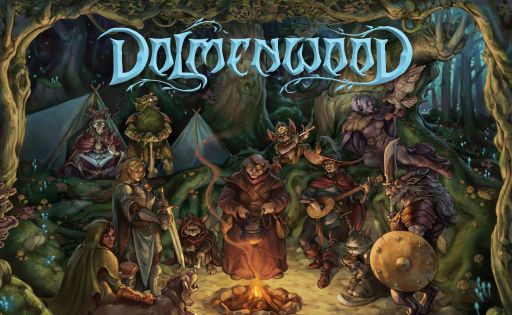
There are books you leaf through and think, “Lovely art, someday.” Then there are books that smell like a campaign, the kind that squat on your shelf and mutter rumours until you give in. Dolmenwood is the latter: three brick-thick hardbacks that look like a children’s fairy atlas left out in the rain and retold by a suspicious uncle. It sits next to my OSR shelf (OSE, DCC, Whitehack) and feels immediately of that tradition, but stranger, greener, and very specifically British in its folklore. It arrives in a cultural moment full of 5E-adjacent fantasy and neon-OSR curiosity; Dolmenwood plants a hedgerow and says “back to the woods, then,” with standing stones, saints’ bones, and a wicked sense of whimsy.
It also helps that the books are gorgeous and deliberate: players get a full-colour Player’s Book (kin, classes, magic, procedure), the referee gets a Campaign Book that is basically a hex-crawl in a trench coat, and the Monster Book hums with redcaps, wyrms, and things that blaspheme both taxonomy and table manners. This is not a generic chassis that begs you to do the heavy lifting later; it’s a fully-stocked larder with a note that says, “Cook.”
Rules: Classic Bones, New Sinew
Under the moss is clean, old-school procedure. Most uncertainty resolves through Skill Checks, Ability Checks, Saving Throws, or Attack Rolls. Skill and ability tests both use d6 (skills target your “Skill Target,” typically 6; ability checks target 4), with the usual “1 always fails, 6 always succeeds.” It’s brisk, legible, and blissfully uniform. Saving throws and attacks step in when swords, spells, and misadventure make their case. Difficulty is nudged with small situational modifiers. If nothing obvious applies, the referee can just set an X-in-6 or percentage chance. It’s B/X energy, modern ergonomics.
Character-facing stuff is tuned to setting. You pick from six Kindred, yes, including goat-headed breggles, fairy elves, cat-fey grimalkin, fungus-bitten mosslings, bat-faced woodgrues, and humbler humans, and nine Classes (Bard, Cleric, Enchanter, Fighter, Friar, Hunter, Knight, Magician, Thief). No sprawling feats or skill lists; instead each class brings a handful of specific competencies and advancement. The result is archetypal, fast-to-scan, and delightfully weird.
Magic is threefold and flavoursome: arcane spells (ranked lists up to 6), holy prayers (up to rank 5), and fairy magic split into glamours and runes; elves acquire secret runes from Fairy nobility as they prove themselves, and they can work glamours as minor talents. It feels like spellcasting wandered into a folklore book and never came out.
On the referee side, procedures are explicit. The Campaign Book gives you weather tables, getting-lost rules, encounter procedures, foraging/fishing/hunting, and hex-by-hex content. It is a hex crawl in earnest, with travel points, visibility and impediments, and seasonal texture that matters. If you’ve wanted a game to mean it when you say “you’re lost in the fog and the road is gone,” this is it.
Setting: Fairy-Tale Weird, With Teeth
The pitch is “British fairy-tale woods” but with a thick skein of history and factions: the Cold Prince (banished fairy lord of Frigia), the Drune (geomantic sorcerers who own the standing stones), the Pluritine Church, human and longhorn (breggle) nobility, witches, and a chaos-godling called Atanuwë who has exactly the sense of humour you dread. This is not a kitchen sink; it’s a tinderbox. The timeline of invasions, banishments, and bargains gives you reasons for winter to bite and shrines to matter.
The hexes themselves are hand-placed curios. One page per hex, many with local traps, lairs, and treasures that want to be used. Take Duke Mai-Fleur’s hunting grounds: paralytic dusk bows, fairy foxes with hidden dens, and the kind of encounter text that becomes a session’s spine if the players look at it funny. The density makes “wander a bit and see what happens” a viable plan and often a terrible one.
The Monster Book isn’t just statlines; it’s a vibe check. Redcaps, wyrms of various humours, woodgrues, witches, and sprites, plus “Talking Animals,” “Wicker Giants,” and other delights, make combat rare but memorable and negotiation alluring but perilous.
What the Designers Are Up To
Necrotic Gnome’s brief is pretty clear: an OSR-forward ruleset tuned to this one forest, with new kindreds, bespoke magic, and the kind of exploration procedures that mean “go off the path” is a mechanical, not just narrative, choice. The books also make running it easy: explicit starting advice, pick-a-settlement guidance, “read these seven hexes,” seed rumours, and even a tiny starter (“Pipes on Droomen Knoll”) so your first session doesn’t quietly become session zero. It signals an intent: minimal prep, maximal curiosity.
How It Plays
Dolmenwood has the OSE pace with Gormenghast flavour. You’re in Prigwort bartering for pipeleaf you shouldn’t smoke, hearing rumours of a saint’s fingerbone lost near the Groaning Loch. A knight wants a message carried to Castle Brackenwold; a mossling warns of Drune rites at a standing stone. The group takes the quicker deer-track, the weather sours, visibility halves, and the “just one more hex” becomes a night in sodden bracken, listening for bells that probably aren’t there. Then a fey bargain appears in the form of a talking fox with pink eyes. You can fight it. Or follow it. Or owe it. The rules will keep up whatever you choose.
Expect sessions to pivot on consequences of curiosity rather than encounter balance. The tension is “what will this cost?” rather than “is this CR-appropriate?” It’s old-school adventure gaming with fairy-law punctuation.
Why Dolmenwood Instead of OSE?
I love OSE Advanced Fantasy as a universal chassis: succinct rules, a cornucopia of classes and spells, and a referee tome stacked with monsters, items, and sober, general advice. It’s the perfect base for your world. But Dolmenwood isn’t a base, it’s a finished instrument. You trade OSE’s broad palette for Dolmenwood’s tuned violin: bespoke kin, classes, fairy magic, and procedures that consistently reinforce one tone (moss-and-myth) plus 200 pages of hexcrawl content, settlements with notable NPCs, and explicit campaign scaffolding. If you want to start a campaign this Friday in a place with a pulse, Dolmenwood gets you there faster and weirder.
Who Is This For?
If you like rules-light, procedure-forward play where the world is the star; if the phrase “Over the Garden Wall but with XP for treasure” makes you smile; if you want a campaign that can run on rumours, roads, and ruined shrines with only a few sticky notes on your GM screen. This is absolutely your kind of trouble. You’ll get immediacy (roll up, pick a road, trouble happens), texture (saints, ley lines, fairy roads), and a strong voice that keeps improvisation easy rather than precious.
Given my tastes (light crunch, strong setting signal, room for discovery) it lands squarely in the “play this soon” pile. The hex density means the GM doesn’t have to work to fill dead air; the factions mean politics will grow without forcing it; the magic and kindreds are just odd enough to keep players curious.
Who Isn’t It For?
If you want tactical grid-lattices, codified character builds, or an encyclopaedia of gear fiddles, you may find the d6-first resolution and archetypal classes a touch austere. If you need a cosmopolitan, planes-hopping scope on day one, the hedgerows may feel confining (by design). And if you want a purely generic toolbox to bolt onto any homebrew, you’ll get more mileage starting with OSE Advanced and sprinkling in Dolmenwood’s ideas piecemeal.
Closing Thoughts
Dolmenwood is that rare thing: an OSR engine and setting that point in the same direction. The rules are quick enough to disappear; the world is loud enough to linger. I can start in Lankshorn, drop a rumour about a Drune stone and a missing relic, roll the weather, and trust the book to catch us when we fall off the path. That’s the promise these tomes make and, unusually, they keep it. If you’ve ever wanted your campaign to taste like blackberry wine and bad bargains, pull your boots on. The foxes are already laying the traps.
Comments
One response to “Dolmenwood: Pixie Boots on Firm Old-School Ground”
I ran two campaigns from the zines.. it’s absolutely dripping with honey and fungus. Delicious and toxic. Mmmm