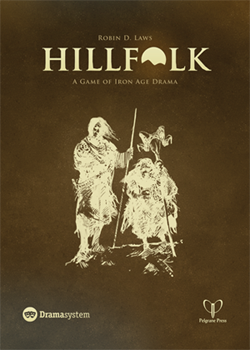
Hillfolk sits on that part of my shelf where the “conversation-forward” games congregate like gossiping aunties at a wedding. But I didn’t come to it for the soap. I came looking for a low-magic, community-first historical game, something that could live in the day-to-day friction of a tribe trying to survive winter rather than the triumphal march of spell lists and gear. What I found was a format that still feels novel to me: half RPG, half TV writers’ room, with sepia art, moody illustrations, and the quiet confidence that the sharpest weapon at the table is a look held a second too long. It carries the DNA of the prestige-TV era: character arcs, slow-burn tension, scenes that end on a knife twist. And it invites you, very plainly, to pour tea, sharpen your tongue, and start a scene.
Hillfolk’s default fiction is “Iron Age drama”, think raiders, rival tribes, droughts, and family claims, but it’s really a platform. The core game teaches you to play serial drama, and then forty-odd “Series Pitches” let you lift that same engine into Hollywood, Moscow Station, Ministry-era scandals, or something with pirate hats. If a|state is Dickensian civic grit and Salvage Union is hard-scrabble mecha co-ops, Hillfolk is the backstage pass to The Feelings, wherever you set them.
How Hillfolk Works (the DramaSystem tour)
Hillfolk splits play into two kinds of scenes: dramatic and procedural. Dramatic scenes are the core loop: a petitioner wants an emotional concession from a granter: reassurance, respect, forgiveness, permission to do something ill-advised, the knife to twist. The granter may yield or rebuff. This is governed by a token economy: if you get what you want, you hand the granter a token; if you don’t, you gain one. Tokens then fuel leverage later (including “forcing” someone to grant a concession once per session if you’ve established the fictional footing and have the currency). This bribes players to sometimes relent, exactly the thing most RPG arguments fail to incentivise.
The other half is procedural resolution (fights, chases, sneaks, survival) handled by playing cards rather than dice. The GM stakes opposition by spending tokens, flips a target card, then players spend tokens for draws; the table reads high-card results, with suits breaking ties and personal consequences on the line. It’s fast, swingy, and deliberately less crunchy than a trad combat engine because the show is still the relationships. A lightweight Bennies pool juices either mode when drama needs a push. It’s all designed to keep momentum pointed at “what changes between us,” with tactics supporting the script rather than stealing the camera.
Character creation is equally to the point. You sketch relationships, state a desire, and pick your dramatic poles (“duty vs. self,” “mercy vs. ruthlessness”). The game then asks you to define “what I want from you” for every other PC. Instant plot hooks printed on your foreheads.
Play is episode-based, players call scenes in turn, anybody can crash a scene if it makes fictional sense, and there’s even a tidy GM Masterclass on pacing, focus, and how to handle the player who’s role-playing a brick wall. (Short answer: reward flexibility, not stubbornness.)
The Hillfolk “Setting” (and why it’s a decoy)
Yes, there’s an Iron Age sandbox (clans, neighbours, geography) but the real setting is the relationship map. You’ll find factions (Rivals, Outlanders), named peoples (Shell-Grinders, Domers), and guidance for doling out background detail as needed. It’s enough to get into trouble, never so much that the lore eats the show. The text is candid about the point: Hillfolk exists because most RPGs handle dramatic scenes badly; this one makes them the engine.
How it Actually Plays
Picture the room: four friends on a Saturday night, a bowl of crisps, a deck of cards. We set a scene: the chieftain’s sister asks the war-leader not to raid the Saltmen; if he dies, the tribe starves. She wants assurance; he wants permission to be terrible. Tokens slide. He rebuffs; she pockets a token and later forces a concession when she corners him before dawn with witnesses.
Cut to a procedural scene: ambush in the thorns. The GM spends for opposition, flips a mean target; our hunter spends to draw and wins, but takes a nasty personal consequence: a scar that will look noble during the next dramatic petition.
The episode ends with a cliffhanger and a pile of altered relationships. That’s a Hillfolk night: less “loot the vault,” more “the vault is Aunt Mera’s approval and you can’t pick that lock with thieves’ tools.”
What the Designers Want You to Do
Robin D. Laws says most tables bog down when PCs argue; DramaSystem pays you to sometimes lose the argument because losing now is how you win later. The whole chassis (scene calling, token economy, “supporting” and “blocking” forces, procedural cards) exists to replicate how fiction actually flows: beat, counter-beat, reversal, fallout. It’s TV logic on purpose.
Compared with a|state and Salvage Union
If we’re talking “community-first” play, a|state and Salvage Union are natural comparisons. a|state is Forged in the Dark: actions, Risk/Reward grid, Stress/Trauma, and a Hope track that literally turns your neighbourhood into a character. It’s superb at externalising pressure via Noise & Attention and a Trouble Engine that escalates like bad weather. You still do missions, roll dice, and fix the corner’s light grid; the drama emerges from consequences.
Salvage Union is post-apoc mecha with a beating communal heart: a Union Crawler home base, d20 core with “tough choices,” Push & Heat for reactor stress, and a loop of salvage to upkeep to craft to go again. It gives you relationships and hard decisions, but the spotlight often rides the machine: ranges, SP/HP, critical tables, and glorious hardware chaos. You can absolutely play it “about people,” but the engine sings when the excavator arm does, too.
Hillfolk is the other way up. It assumes the relationship is the scene and the spear fight is a commercial break. If you want to make the talking not just allowed but compelling, Hillfolk beats both: fewer subsystems, a currency that bribes vulnerability, and procedures that keep the whole table inside the same minute of television. If you want the world to push back with clocks, resources, and heists, a|state wins. If you want mech-scale logistics and crunchy set-pieces, Salvage Union wins. Different levers, different highs.
Who is Hillfolk For?
If your group lights up when someone says, “I need you to say you’re proud of me,” this is your dessert. If your favourite session beats are the hard apologies, the ill-advised vows, and the moment someone finally admits what they want, Hillfolk will hand you tokens and tell you to get on with it. It’s also disarmingly good for campaign TV: players call scenes, weave A/B plots, and you get seasonal arcs without a whiteboard ulcer. Add the dozens of Series Pitches, and you can do clan drama this month and newsroom ethics next.
Given my tastes (low crunch, high consequence, communities that remember what you did), Hillfolk sits beside a|state as “games I can run on a Thursday with three lines of prep.” Where a|state gives me a city that fights back (Hope, Noise, Trouble) Hillfolk gives me people who fight back with the only weapons most of us ever really have: need, leverage, and the occasional ill-timed admission.
Who is it Not For?
If you want tactical grids, gear porn, or detailed heist machinery, Hillfolk will feel like an exquisitely written meeting that never ends. If your table needs a GM-driven plot to bite into, the scene-calling economy may feel unnervingly democratic. And if the idea of being gently bribed to lose the argument makes your hackles rise, this currency will itch. That’s not a flaw; it’s the point.
Closing Thoughts
Hillfolk is the game I think I’ll pull down when what we care about most isn’t whether we win, but what winning costs us together. Even just reading it, it feels elegant and tightly aimed: drama as the engine, escalation as a habit, and enough structure to turn “can we just stay with this conversation a bit longer?” into the actual point of play.
I can see myself reaching for it when I want low-magic, community-focused history with sharp social stakes, a table that’s up for scenes that linger, relationships that get messy, and decisions that leave bruises. On nights when I want the world to punch back with gear lists, pressure, and problem-solving, I’ll still grab a|state or clamber into a Salvage Union cockpit and make some noise. Different evenings, different cravings. But when I’ve got a group that enjoys character friction and cares about the collective, Hillfolk is the one I’m most curious to actually put on the table.
Comments
2 responses to “Hillfolk: Talk First, Fight Later (Maybe Much Later)”
Thanks. I’d been looking for something that’s a nearer fit to what I’ve been trying to do, and it sounds like Hillsfolk (or more accurately, DramaSystem) is pretty close.
It’s a bit of a coincidence that you used Salvage Union as a comparison, as that’s a game I’d seriously considered running. I love the implicit setting, and I’d played in some one-shots with the designers. But I was frustrated that in play, the other players focused on combat, and in the official Discord, most of the discussion was about mech builds. I realized, finally, that was exactly how it was designed. The tensions between corps and wastelanders, with salvagers in between, sets the context for everything, but that’s not the focus of play. It’s an excellent game, but not what I’d been searching for.
I’d been most interested in Fate Core, which has Fate tokens, which have a somewhat similar role, in that you gain Fate tokens by accepting defeats and distractions, and use them later to make successes more likely. As designed in Fate, you could use them in social conflicts as well as in “conventional” action-adventure conflicts, though most often in Fate circles the latter seems assumed. When I’d read Hamlet’s Hit Points, by Robin Laws, I’d imagined Fate tokens as a way to encourage upbeats and downbeats, though this system that Laws designed is clearly more directly based on the idea.
Also, when I’ve tried running Fate, I’ve found that the players didn’t really quite understand the importance of describing relationships as fundamental to the system. In part that’s my fault, for failing to emphasize the point, but I think Fate Core also tried too hard to look like trad games such as GURPs, so people don’t intuit its particular features. Those seem much more prominent with Hillsfolk.
Totally get this and yeah, I really recognise that Salvage Union experience. The setting is so my jam, but if the gravity at the table (and in the community) is builds + fights, you end up pushing uphill if what you want is relationship-first play. “Great game, wrong tool” is exactly the right conclusion. I tried it with a group and that’s where it landed for me too. Still wanna try it again but have to think what the preamble looks like to get a group that’s into what I want to explore.
And your Fate point comparison lands for me too. In theory you can absolutely use compels/tokens to drive that Hamlet’s Hit Points beat shift vibe, but in practice Fate can look trad enough that people don’t instinctively treat relationships/aspects as the main event unless you hammer it in from the start. DramaSystem feels way less subtle about it.. the rewards are tied straight to what you want from other people, not to “did we win the scene.”
If you do try it, I’d love to hear whether it fixes that “players didn’t quite get the relationships are the system” problem for you, or whether it turns out to be mostly onboarding/table expectations rather than mechanics.