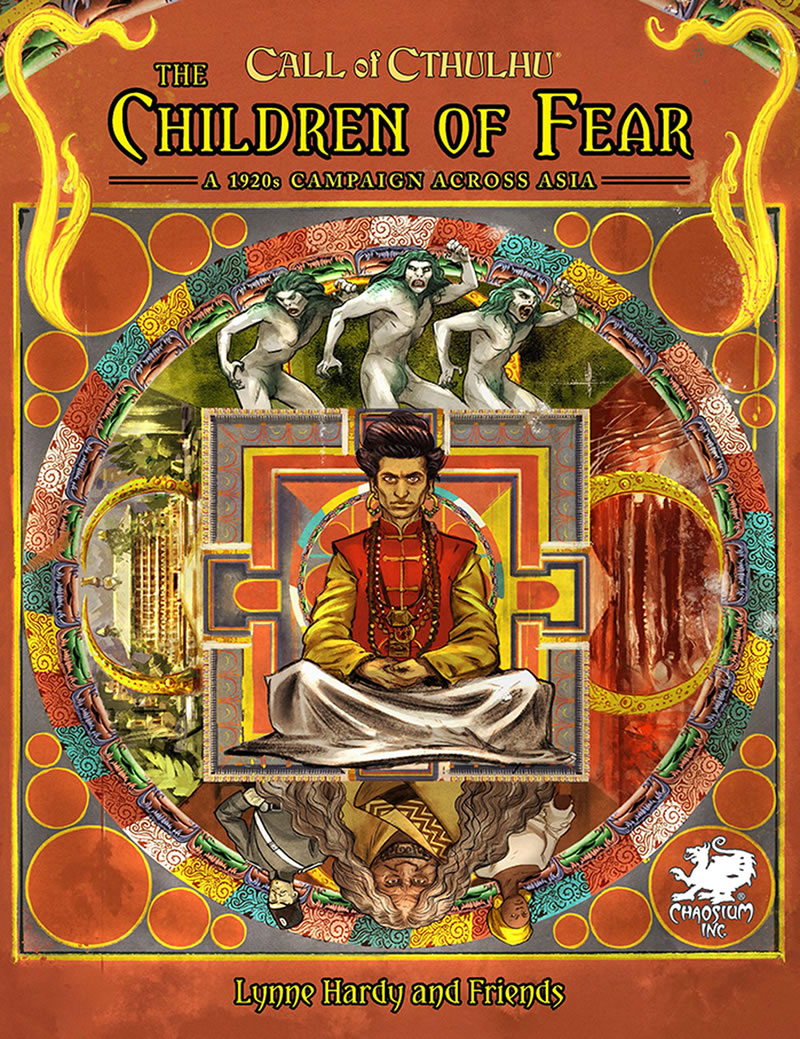
20 September 1923, Peking. In the Foreign Legation Quarter the air always feels a little staged, as if the city has been asked to stand politely behind a rope while the West takes its tea. Outside those streets, Peking is vast and alive and complicated. Inside them, the rules are clearer, the uniforms sharper, the smiles more practiced. It’s a useful place to begin a journey into the unknown: bright lights, clean tablecloths, and the comforting lie that nothing truly strange can happen here.
The investigators gathered at the Hotel des Wagons-Lit, drawn together by the usual gravity of the Midnight Society. Some knew each other well, others only by reputation and introductions made in smoky rooms, but they all shared the same basic understanding: the world has seams, and if you pull at them long enough they start to come apart. Each had received the same invitation to a lecture “The Long Road of Travel” and more tellingly, a handwritten note asking them to attend from Professor Wang Enlai of Yenching University, a friend and contact of the Society.
Miriam Ashcroft was already present, as if she’d been seated an hour before anyone arrived. She had that calm, well-made look of someone who keeps her thoughts arranged in labelled drawers, and she wrote in her observation notebook with steady focus. Beside her sat “Ravi,” a young, wealthy Indian boy with a fine turban and the slightly too-perfect stillness of a child who has learned to perform adulthood. Anyone paying close attention could feel the tension between costume and truth: “Ravi” was Zahra Jahan, disguised with the ease of a master thief wearing a mask like a second skin.
Lee Xie Liling arrived next, dressed well enough to pass through the Legation Quarter without trouble, though there was a touch of disarray to her in the way of someone who had lived in libraries and lecture halls rather than parlours. She had studied psychology in Berlin, and she carried herself like a person who observes people as systems, habits and fractures, rather than as stories.
Joe Morton followed, lean and sharp-featured, wearing his suit the way a reporter wears credibility: deliberately, like armour. Thirty years old, Chicago, restless with the sense that the next important thing is always just ahead.
Fred Wiederstein came last, tall and distinguished in the unmistakable way of a United States Marine who has spent long enough overseas to stop believing the world makes perfect sense. Every so often his hand drifted to an ornate pocket watch, as if the weight of it reassured him that time still moved in a straight line. Kenji Kano had been observing the group before he joined: young, calm, intelligent-looking, with the quiet self-possession of a scholar who is also a martial artist.
They spoke, as people do at the beginning of these things, about how they’d come to the Midnight Society. No one gave their whole story on the first meeting. The acceptable version surfaced first: education, experience, curiosity, a brush with something unexplained that left behind a persistent itch to keep looking.
The first sign the evening was going to go wrong was the food.
Drinks arrived promptly, as if to reassure the room that ordinary laws of cause and effect still applied. The meal did not. Minutes stretched into a half hour, then longer. The dining room wasn’t even especially busy, but staff lingered along the walls in a way that suggested they wanted to stay close to something solid. Their server was nervous in the particular way of someone trying to act as if she isn’t, movements tight, rehearsed, eyes flicking toward the kitchen as though she expected it to bite.
When questioned, she offered evasive answers and hovered at the edge of the room. Ravi – Zahra, under that smooth disguise – leaned toward the swinging kitchen doors and peered through the small window. Beyond the glass, staff clustered around the hob. There were no flames, no smoke, no obvious accident, just a man lying partly under the stove as if he’d crawled there to hide. He wore some kind of denim coverall, the sort of work clothing that didn’t belong in this polished hotel kitchen. The scene had the wrong texture, like a detail from another world pasted badly into this one.
Lee rose and approached the doorway, speaking in Chinese. A large waiter moved to block her, too quickly, too firmly, and insisted the kitchen was closed due to a minor mechanical issue. He promised everything would soon be resolved. He said it like a man reciting a prayer. Lee understood him perfectly, and she could hear the fear beneath his words. He didn’t believe what he was saying. He was trying to make himself believe it by speaking it aloud.
At that point, staying felt like participating in someone else’s mistake. The investigators decided to leave.
The manager attempted to charge them for drinks they hadn’t ordered, an insult delivered with the smile of a man accustomed to foreigners who can’t argue back. Miriam corrected him calmly and precisely, listing what had been served and what had not as if she were reading from a ledger. There was no drama, no raised voice, just the quiet certainty of someone who remembers the truth with unnerving fidelity. The manager’s smile tightened, the charges vanished, and the group stepped out into the Legation Quarter night with nothing in their bellies but suspicion.
Kenji offered them a ride to the lecture in his Ford, and the simple act of leaving that dining room felt like stepping out of a held breath. Peking at street level had its own rhythm: vendors calling, lantern light, the smell of oil and spice, the press of people moving with purpose. They grabbed street food along the way, noodles, jellyfish salad, whatever was quick and hot, and for a few minutes it almost felt like the night had merely gone sideways rather than strange.
Then the noodle seller fell.
It might have been nothing: an elderly woman losing her footing, a simple accident in a crowded street. But Miriam’s attention sharpened, and she had the sudden prickling sense that the fall was a distraction, misfortune staged to pull eyes and hands away from where they should be. Kenji, scanning the street with quiet vigilance, spotted a man watching them: a figure dressed like a Chinese labourer, posture slightly too still. When Kenji met his gaze, the man slipped away into the crowd with practiced ease.
When the investigators tried to move on, Kenji’s car refused to start.
It was the kind of irritation that felt small until it began to rhyme with everything else. First a delay with the food. Then an awkward incident in the street. Now a mechanical failure at the exact moment they wanted to leave. Nothing catastrophic, nothing scandalous. Just a sequence of soft obstructions, a gentle hand placed on the shoulder to keep them in place.
They fixed the Ford, coaxing the engine back into cooperation, and arrived at the lecture hall late enough to miss whatever polite preamble had been planned.
Inside, the room was crowded. A magic lantern had been set up, the screen waiting at the front like an empty eye. With most seats taken, the investigators scattered into the few available gaps, separated by strangers. The lecturer, Mr. Bazaz-Wain, had the look of a man who had seen too much sun and too many hard miles. He spoke of the Silk Road as if it were a single thing, but even in his telling its true nature came through: not one road, but a braided web of routes shifting with politics, bandits, drought, and empire. The Han pushing west, caravans threading between deserts and mountains, oasis towns rising like small miracles, the long pull toward the edges of China where the land turns harsh and the horizon feels hungry.
He showed images from his travels, geography made strange by distance, and then he began to show the ones that mattered: photographs of the Thousand Buddha Caves, carved sanctuaries filled with painted divinities and shadowed recesses. The faces in the murals were serene, but the caves themselves looked like wounds in the earth.
Halfway through, the lights went out.
For a heartbeat there was polite confusion, the shuffle and murmur of an audience trained to tolerate inconvenience. Then there was a flash, a hard, invasive light that didn’t illuminate so much as overwrite. It hit the senses like a fist. And in that instant, each of the investigators fell into a vision that felt less like imagination and more like memory.
Fred was barefoot in sand under early morning sunlight. A horde of rats streamed over low hills, flowing past him in living waves, their bodies brushing his feet with a warm, ticklish insistence. It wasn’t simply disgusting, it was intimate, as if the world had decided to touch him and would not be denied.
Joe stood in a beautiful hall filled with display cabinets, the air clean and still as a museum. In the centre was a console holding a golden Buddha. It looked wrong in the way of an almost-human face: something about the arms, the expression, the suggestion of movement. Joe felt, viscerally, that it was reaching out from behind the glass, drawing him in, arms opening not in blessing but in possession.
Kenji was somewhere hot and sour, the air thick with lice, sweat, urine, manure. He watched a man, Indian, short, bone-thin, wearing only a white cloth wrap. The man’s skin was dusted in grey ash, and he stacked bones of many sizes with careful intent, building an altar as if assembling a sentence in a language older than words.
Miriam sat on the ground near flickering firelight. The smell of iron and mud clung to the air. When she looked down at her hands, she saw blood and dirt caked under her nails and across her fingers. There was a moment of disorientation, not why there was blood, but the dawning realisation that the blood belonged there, that this was not a metaphor but a fact.
Ravi (Zahra) felt comfort and confinement at once, like standing in a courtyard that was open to the sky yet impossible to leave. Spring light washed over a blossoming orchard of fruit and nuts. Ahead walked a tall man with long braided hair and strange clothing covered in moving patterns, shifting like living script no one could quite read. Beyond him was a bright, glowing light that felt like invitation and threat in equal measure.
Lee watched the lecture hall fold in on itself, the walls and ceiling compressing until space became dense. Then the room was gone, replaced by thick vegetation, jungle growth heavy and wet, except snow lay on branches and ground, wrong and quiet. Lee felt sucking touches on her arms, shoulders, ears, toes. Leeches. Dozens of them, clinging, feeding, cold and wet and hungry all at once.
And then, as abruptly as it began, they were back.
The lecture hall returned in pieces: murmurs, shifting bodies, someone lighting a lantern. Professor Wang apologised for the interruption with the strained calm of a man trying to pretend the world hadn’t just cracked open. Kenji, Miriam, and Ravi whispered together, and Ravi suggested the bone-stacking figure in Kenji’s vision might have been a sadhu. Lee, listening to the room as she always did, caught a separate thread of unease: a conversation in Chinese about the building being unlucky, the fourth constructed on the site, the number itself carrying the shadow of death in its sound.
When the magic lantern resumed, the images of the Thousand Buddha Caves landed differently. The carved spaces, the painted walls, the desert geography around them, too much of it echoed what each investigator had seen in those stolen moments of vision. Different scenes, different textures, but all tugging toward the same place, as if fragments of a single map had been laid over their minds.
After the lecture, Professor Wang sought them out with the urgency of someone who had been carrying bad news for too long. He was pleased to see them, genuinely, and also plainly frightened. He told them he’d contacted London and Miskatonic about a missing colleague: Langdon Warner, part of an expedition to the Thousand Buddha Caves that had gone silent. Then he produced the telegram he’d received from Tun-Huang, its message blunt enough to strip away all academic politeness.
Need urgent help. Send people immediately, don’t care who. Just get them to Tun-Huang. Emergency.
Wang had funds, limited, but real, and a local contact who could help arrange travel. What he needed was a group willing to go into the long inland distances where roads become rumours and the landscape has room to swallow you whole. He looked at the investigators as if he already knew the answer, because in truth he did. People like this didn’t gather in a hotel dining room by accident. Not when the food was delayed, the staff were afraid, the street itself seemed to trip them, and the lights went out at the precise moment someone showed photographs of a place they had never been, yet somehow recognised.
Individually, none of it would be enough. Bad service. A fall in the street. A stubborn car. A power cut. But taken together, it felt like the first careful tightening of a net.
And the net, it seemed, was drawing them west: toward Tun-Huang, toward the caves, and toward whatever had reached out through the lantern light to put its hands on their minds.