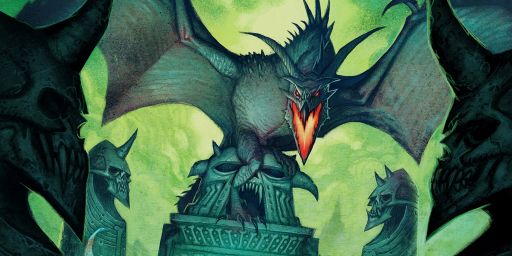
Morning in Outskirt comes grey and damp, the sort of light that makes the palisades look taller and the hills beyond a little less inviting. Inside the Three Stag Inn, the smells of porridge and smoke do their best to make the world feel normal again. Silas sits with his grief and a mug he barely touches, the absence of Willow like a pulled tooth in his jaw. When the others shoulder their packs and speak of the Riddermound, he stays behind for a time, claiming unfinished business in the village. In truth, everyone understands he is not ready to stare another monster in the face just yet.
So it is that Ruskin, Luna, and Thromli leave Outskirt without their merchant companion, following the northern road into the Misty Vale. The map from the dying man in the pass has been studied and refolded so often the creases are starting to fray, but the mist plays tricks and the land is a patchwork of identical-looking slopes and copses. Before long, they realise they have walked themselves into a slow loop, circling back towards the village they only just left.
That is when they hear the familiar clatter of a cart and the soft braying of another donkey. A stout halfling in a well-patched waistcoat rounds the bend, perched atop a creaking, donkey-drawn wagon piled high with crates and bundles. He introduces himself as Theobald, a travelling merchant with an amiable smile and the sort of eyes that never stop weighing possibilities.
Theobald has pots and pans, coils of rope, vials whose contents he assures them are “probably” safe to drink, and a smattering of better-quality goods tucked away for those with coin and a need. Ruskin cannot help himself; haggling is as natural to him as breathing. But they have little to trade, having sold off their few trinkets from the goblins, and come away empty handed.
Theobald is keen to hear their news. The Misty Vale is stirring and men like him survive on stories as much as trade. He listens, wide-eyed, to the tale of goblins in the pass and a troll in Mifaldor’s barn, tutting sympathetically when Willow’s fate is mentioned. In exchange he shares rumours of barrows in the western hills, old dragon-empire ruins half-swallowed by earth, and a burial mound crowned with standing stones where the air tastes wrong. His description matches Vagnhild’s whispered account of the Riddermound a little too well.
With their course corrected, the party turns west. The land rises and falls in a series of low, heather-clad ridges. Here and there the earth bulges into unnatural humps, the outlines of burial mounds softened by moss and time. As the day wanes, they spot the broken teeth of an old fortress jutting from a hillside a short distance into the barrowlands.
The ruin is a relic of the dragon empire, its walls long since collapsed into scattered segments of dressed stone. Ivy curls over carved reliefs, but enough remains visible for the party to trace the shapes: a figure in a horned dragon helm riding a serpentine beast, banners streaming, armies bending the knee. The stone is weathered yet the arrogance etched into those lines still lingers.
Exploring among the tumbled blocks, they eventually find a half-hidden opening descending into a buried cellar. The air below is cool and dry, dust motes turning in a shaft of dim light. In the corner, beneath fallen beams, they pry open an ancient chest whose iron fittings crumble at their touch. Inside, wrapped in the remnants of rotted cloth, lie a handful of silver trinkets and coins that catch the light in a way that makes Thromli’s eyes gleam.
They camp near the ruin that night, firelight flickering against dragon-carved stone. The wind sighs through the broken walls like distant voices. Come morning, they shoulder packs grown slightly heavier with newfound treasure and press on into the trees, hearts set on finding the Riddermound.
They know they are close when the hills begin to fall silent around them. Birds that chattered all morning fall quiet. Even the wind seems to thin out. A low hill swells from the earth, crowned with tall standing stones darkened by lichen. The air carries a faint, putrid stench, like vegetables left too long in a cellar.
Climbing the slope, they see that the grass is churned and trampled. Signs of passage criss-cross the ground: boot prints, smaller, three-toed tracks, the paw-marks of wolves. Something clearly uses this hill as more than a place to remember the dead. At the crown of the hill lies a rough-hewn stone slab, square and heavy, set into the earth. It has been shifted just enough that a finger of darkness shows along one edge.
With grunts and careful leverage, they slide the slab aside. A breath of air exhales from below, stale and cold, carrying the dry tang of old bones. Beneath yawns a vertical shaft, walls swallowed by shadow. They knot a rope around one of the standing stones and descend, one by one, boots scraping against stone until they drop into a dome-shaped chamber whose ceiling curves away into darkness. Above, the opening to the surface is a dim, distant square of light.
The floor is beaten earth, tamped hard by countless steps over the centuries. In the north wall stands a set of heavy oak doors bound in iron. A silvery symbol stretches across their surface, glittering faintly in the gloom: a stylised crown, its points like dragon horns. Stone statues of knights in archaic armour flank the doorway, their eyeless helms fixed on the intruders. The doors themselves have been forced open from the outside and now stand slightly ajar, hinges protesting softly whenever the draught shifts them.
The three adventurers are not the first to come here. The floor is a mess of prints: wider boots, smaller bare feet, the drag of something heavy being pulled through. Thromli studies the crowned symbol with a frown, remembering Vagnhild’s talk of a dragon-worshipping kingdom that once ruled the Vale. The same motif appears in the village statue, on the map, on the reliefs at the ruin. The Dragon Emperor’s shadow lies long, even beneath the earth.
They edge deeper into the antechamber, eyes straining to follow the curve of the ceiling. Only then do they notice the iron chain hanging from above, suspending a large, soot-blackened cauldron almost directly over their heads.
The first bat erupts from the cauldron like a piece of the dark itself, shrieking as it dives. A heartbeat later the air is full of them: a whirling storm of leathery wings and needle teeth, circling, clawing, going for exposed throats and eyes. Torches thrash, blades flash, and for a few moments the Riddermound is chaos, the chamber lit in wild, jumping light as they fight to keep the swarm from enveloping them.
It is over as quickly as it began. The last bat hits the ground with a wet thud, wings twitching before it stills. The cauldron swings gently on its chain, empty now but for a smear of guano and the faint echo of tiny bones. Scratched and bleeding, chests heaving, the party takes stock and presses on.
Beyond the antechamber they find a smaller room whose packed earth floor is lit by the flickering glow of a torch somewhere out of sight. A black iron portcullis blocks the way, bars thick with rust, the gaps just wide enough to glimpse more stone beyond. Two mummified figures stand on either side of the gate, guards in long-rotted chainmail, hands still clasped around the shafts of their spears.
No breath stirs their shrivelled lips. No eyes watch from hollow sockets. The party approaches cautiously, half-expecting the corpses to lurch into motion, but they remain lifeless, armour flaking to rust at the slightest touch. The portcullis reacts no better, when Ruskin tests one of the bars it groans ominously and showers a cascade of orange dust. Forcing it seems as likely to bring the whole thing down in a jagged heap as to open a path.
As they debate their options, something moves in the shadows of the tunnel behind them. A hairy leg as thick as a child’s arm stretches from the darkness, followed by another, then the bulk of a giant spider dragging itself into the torchlight. Its eyes catch the glow and glitter. Its mandibles click eagerly.
The fight that follows is brief and ugly, steel on chitin, fangs snapping inches from faces, Luna’s arrows hissing past Thromli’s shoulder. When the spider finally collapses, greenish ichor pooling beneath it, the three of them are left with another set of wounds and the sharp understanding that the Riddermound is far from empty.
With the route through the guardhouse blocked by rust and prudence, they turn east into a different passageway. The air grows heavier as they walk, damp seeping from the walls, the smell of old dust and older decay thickening.
The family crypt is a low chamber cut from the earth, its floor packed hard. Seven stone sarcophagi line the walls, simple and unadorned. Several lids lie cracked and askew. Two skeletons have been swept unceremoniously onto the floor, bones scattered as if by impatient hands. Goblin bootprints criss-cross the dust, and here and there the party spots the scuff-marks of pry bars and knives.
Three of the seven tombs have been plundered, their occupants’ remains tossed aside. Four still hold their dead, laid out with a care that time has not entirely erased. Ceremonial garments cling in rotting shreds to their bones. Gold gleams faintly at wrists and brows, gilded headbands, rings set with cloudy stones. Some of the bones are slender and small, child-sized, which gives even hard-bitten Ruskin pause. The wealth buried with them would buy a great deal of comfort on the surface. After a moment’s silence, the party takes the headbands and rings, tucking away the treasures of a family whose name no one now remembers.
It is then that they hear it: a slow, grinding scrape of metal on stone from the passage beyond. The air temperature seems to drop. A figure fills the doorway, tall enough that its helm nearly brushes the lintel.
The wight wears antiquated plate armour, the metal dull with age yet unnervingly solid. A horned great helm obscures most of its head, but through the open visor they see a skull’s grim grin and eye sockets lit by a faint, baleful glow. Each step it takes is accompanied by that awful scraping sound, as if the very mound hates its movement.
They meet it in the archway, blades and arrows flashing, but every blow feels wrong. Steel that should bite deep skitters or sinks only a fraction. The wight’s return strikes, by contrast, are like hammer blows, numbing arms and rattling teeth. In the tight confines of the passage, with wounds from spiders and bats already slowing them, the party realises it is badly outmatched.
Retreat is rarely heroic, but it is sometimes the only choice. Step by painful step, half-dragging each other, they fall back towards the antechamber, the wight’s implacable tread echoing behind them. Only when they reach the threshold of that first room does it halt, as if some unseen line has been drawn in the packed earth. It stands there for a long moment, silent and watchful, before turning away and vanishing once more into the depths.
Badly hurt and shaken, the adventurers decide that the mound is more than they can face in their current state. They haul themselves up the rope, emerge blinking into the daylight atop the hill, and stagger a short distance away to catch their breath. The hills seems almost bright by comparison, the chill air a harsh relief.
They do not have long.
Goblins boil out from behind trees and rocks as if the land itself has turned hostile. The party is caught in a tightening ring of blades and jeers. These goblins are no lone scouting pack: they move with the confidence of numbers and the assurance of having the high ground. Crude spears jab, arrows threaten from the tree line. In their weakened state, the three weary adventurers can only mount a brief, desperate defence before one by one they are beaten down, consciousness slipping away like water between fingers.
When they wake, it is to the ache of bruises and the bite of rope around wrists and ankles. The sky is pale, the light thin. They are alive, which feels like a mistake.
Goblins squat around them in a loose camp, sharpening blades and arguing over scraps. Goblin children point and laugh, mimicking Thromli’s bagpipes with rude noises while the real instrument lies trussed up with its owner, a dirty rag serving as his gag. Ruskin does most of the talking, his tongue as quick as ever even with a split lip.
Through threats and bartered flattery, they piece together the situation. These goblins answer to an orc chieftain named Maladûk and, like Leanara and the Truth Society, they are hunting pieces of a statuette tied to the Dragon Emperor. One such fragment, identical to the one hidden in Ruskin’s pack, is rumoured to lie within the Riddermound. The goblins sent a party down before; none returned.
As far as Maladûk’s followers are concerned, this presents an opportunity. Why waste more of their own when they have three capable prisoners ready to be shoved down a hole? Spears press against ribs as the terms are laid out: venture back into the mound and retrieve the statuette fragment, or die here and now and save everyone the trouble.
It is an unenviable choice, but the only one on offer. The party agrees, each privately calculating how they might wriggle free of goblin expectations later. For now, they are escorted back to the stone slab and forced down into the darkness once more.
What the goblins do not know is that they are no longer alone.
Silas, heavy-hearted and restless in Outskirt, had set out after his companions later that same morning, following their tracks along the northern road. He arrives at the hilltop glade to find goblins everywhere, their camp strung between the standing stones, and no sign of his friends but the fresh scuff marks of their passage. Keeping low, he skirts the edge of the hill and watches. When a gaggle of goblins wanders off arguing over something shiny, leaving the shaft momentarily unwatched, he seizes his chance.
With the practised stealth of a merchant used to slipping away from unpaid tabs, Silas slides the slab just enough to squeeze through and lowers himself into the antechamber. There he finds Luna and Thromli, battered but alive, their faces lighting up in relief at the sight of him. In whispers, they bring him up to speed on goblin demands, undead knights, and the draconic crown motif that keeps surfacing wherever they turn.
Four once more, though thinner in spirit, they resolve to try a different route through the Riddermound. This time they turn west from the antechamber, into a tunnel that slopes deeper into the earth.
The servants’ crypt feels different from the family tomb. Here the walls are honeycombed with burial niches, stacked from floor to ceiling, each once home to the remains of a retainer whose name has faded from memory. Many have been disturbed. Skeletons lie half-pulled from their resting places, limbs askew. Pottery jars lie shattered, their contents long since turned to dust. Torn scraps of cloth flutter faintly in the stale air. Whoever came before was not gentle.
As Thromli circles the room, he spots another iron portcullis set in the stone, a twin to the one by the guardhouse. The bars are intact here, the lock still apparently functional. Luna, meanwhile, notices something else: a quiver in the pile of bones near the floor, too deliberate to be the settling of old remains.
They close in, weapons ready, and a small, terrified face peers back at them from between a pair of ribs. It is a goblin, clutching a ring of keys so tightly his knuckles have gone pale green. His chest heaves with panicked breaths. This is Grub, the last survivor of the previous goblin expedition, and he is very clear on his priorities. He wants out.
His first instinct is flight, but with Silas blocking one exit and Ruskin the other, there is nowhere to go. After some gentle words and a promise that they are not, in fact, planning to kill him, Grub stammers out his tale. He and his mates came down here hunting the same treasure the party now seeks. Most never made it past the wight. Grub ran and hid among the bones, clutching the key ring he managed to snatch from the guardhouse before something in the dark took his friends apart.
He has tried one of the keys on the nearby portcullis; it snapped off in the lock with an accusing crunch, leaving the mechanism jammed. The others, however, might yet work elsewhere. If the adventurers will escort him to the antechamber, the one place in the mound the wight seems reluctant to enter, he will gladly hand over the remaining keys and swear to tell the goblins above that the party perished below.
It is a thin bargain but better than nothing. Keeping a wary eye on the shadows, they shepherd Grub back through the tunnels to the shaft room. His relief on reaching the patch of earth where the wight will not tread is almost painful to watch. He presses the rusted ring of keys into Ruskin’s hand, squeaks a promise to spread news of their “heroic demise”, and scrambles up the rope without looking back.
Alone again, the party turns once more into the westward passages. They skirt around the family crypt, giving the wight’s domain a wide berth, and make for the other portcullis they glimpsed beyond the guardhouse wall. The corridor narrows here, forcing them into single file.
They are almost upon the gate when the floor drops away beneath Ruskin’s leading foot. Only a frantic grab at the edge saves him from tumbling into the black pit that yawns where solid ground should be. As he hauls himself back up, breath coming in gasps, something large and spidery spills from the ceiling, drawn by the sudden noise.
The second spider is no less eager than the first, mandibles clacking, spinnerets twitching. The fight that follows is messy and frantic, made worse by the treacherous hole at their feet. Luna’s arrows thud into its body, Thromli’s pipes blare a note more suited to war than taverns, and Silas and Ruskin dart in and out with blades. In its death throes, the spider flails and topples, tumbling into the pit it had intended for them. The sound of its impact echoes for a long moment before fading.
As the last of the vibrations die away, another figure appears, silhouetted in the tunnel mouth: an elf knight in travel-stained mail, a longsword at his hip and a shield bearing a faded crest. He introduces himself as Gildhared, a wanderer drawn to the Riddermound by the same dark stories that reached Outskirt. Hearing the sounds of battle, he hurried to lend his arm. Fate has, perhaps, a cruel sense of timing.
With Grub’s remaining keys, they turn their attention to the intact portcullis. This time the lock yields with a complaining squeal, and the gate creaks upward enough for them to duck under into the room beyond.
It is a small hall, its walls hung with torches that burn with an oddly steady flame. An oak table stands in the centre, its surface remarkably intact. At the far end sits a mummified woman in gilded chainmail, hands folded in front of her as if awaiting guests. Behind her, an iron-banded door bears another of those glittering silver symbols.
The air here feels different, thicker, charged. On the table rests a warhammer whose head is engraved with snarling fiends, the metal dulled but the lines still sharp. When Thromli reaches out and lifts it, the room grows colder.
The mummified woman’s eyes open.
Her flesh peels away like smoke, leaving behind a tall, translucent figure shimmering faintly blue. Chainmail drapes over her form, more suggestion than metal. A gilded headband gleams at her brow. Her face is grave and sad, the face of someone who has waited a very long time and is disappointed by what she has found. She speaks, voice echoing in a tongue none of them understand, the cadence nonetheless clear: this place is to be left alone. Her hand lifts, pointing back the way they came.
The party has not come this far to turn back at a scolding, even a ghostly one. When they make no move to retreat, when Thromli, hammer in hand, glances instead at the door behind her, the Lady’s face twists. The sadness burns away, leaving only rage. Her features stretch into a terrible mask as she lets out a sound that is more feeling than noise, a cold, tearing shriek that seems to claw at their hearts.
What follows is less a fight and more a lesson in how fragile living flesh can be. The Lady moves with uncanny speed, flickering from place to place, her hands passing through armour as if it were mist. Where she touches, warmth leaches away. Chests seize as if invisible fingers have closed around hearts. A single look freezes courage, dredging up every guilt and failure they have ever tried to bury. Torches gutter. The Morréndín warhammer, Fiendcrusher, feels heavy and unfamiliar in Thromli’s grip, an instrument forged for this very purpose yet alien to his hands. Their desperate swings with fire and blessed steel land, but too rarely and with too little force.
Already battered by the day’s ordeals, the group begins to fray. Silas staggers, breath coming short, vision swimming with the faces of Willow and the people he failed to swindle. Luna’s hands shake as arrows slip from numb fingers. Ruskin curses between clenched teeth, trying to keep between the ghost and his friends, while Gildhared plants himself like a wedge, shield raised, jaw set.
Seeing the battle turn against them, Thromli makes a rash decision. While the Lady’s attention is fixed on the others, he slips sideways and shoves the iron-banded door open.
Beyond lies the heart of the Riddermound: a stone chamber lit by torches whose flames do not flicker. In the centre stands a podium bearing an ornate sarcophagus. Its lid lies shattered on the floor in massive chunks, as if something inside burst it apart from within. On the far wall, a painting shows a dragon being ridden into battle, wings outstretched, jaws open. Inside the broken coffin, among the scraps of burial cloth and the imprint of a body long gone, something glints: a gilded crown shaped like dragon horns.
Thromli has just enough time to register its existence before the air grows heavy again. The temperature drops. From the shadows at the edge of the chamber, the wight steps forward, summoned by the disturbance in his resting place.
Pinned between an enraged ghost and an ancient death knight, the adventurers are finally overwhelmed. The Lady’s touch takes Silas first. His heart lurches under her spectral hand, then stills, his body crumpling at her feet. Ruskin, eyes wide with disbelief, throws himself at the wight in a last, furious rush and is swatted aside, armour buckling. Gildhared holds the line as long as anyone could ask, blade ringing against the wight’s great weapon, before a single, crushing blow sends him to the floor.
Luna, seeing the ruin around her and hearing Thromli’s choked warning, breaks and runs. It is the only reason she lives.
Thromli himself fights until he can no longer lift Fiendcrusher, until his arms are lead and his ears ring with ghost-scream. The Lady’s hand closes around him; icy pain floods his chest, and the world goes black.
What happens next he only knows in fragments. The ghost, its fury spent, fades back to whatever liminal place held it. The wight, duty fulfilled, turns from the sprawled bodies and returns to its sarcophagus. Silence falls over the Riddermound once more.
Later, minutes, hours, he cannot tell, Thromli’s eyes snap open. Every breath hurts. He lies alone on the cold stone, the hammer beside him. Somehow, by stubbornness or accident, he has slipped the grasp of death by the width of a hair. Crawling more than walking, he drags himself out of the Lady’s hall, away from the bodies of Silas, Ruskin, and Gildhared.
He finds Luna in the antechamber, knees drawn up, bow lying forgotten at her side. The wolfkin’s normally steady gaze is raw. Between them, words feel inadequate. They sit together in that cramped, dirt-floored room, listening to the distant creaks and whispers of the mound, knowing that for all their bravery and schemes they have barely survived a first brush with the Dragon Emperor’s long shadow.
Above, goblins argue around their fires before abandoning the party for dead. Below, a crown waits in a broken coffin. In the antechamber, two grieving adventurers steel themselves for whatever must come next.