I’m doing this review because I’ve got The Evils of Illmire sitting on my desk like a wet promise. I want to run a hexcrawl. I want the feeling of a map full of bad decisions, where the party stares at a stretch of swamp and argues about whether the safest path is the one with the least fungus.
But Illmire has a way of exposing what you actually want from a fantasy system. I want low-level peril without “everyone bring three spare cousins.” I want players to have enough character-build texture to feel like they’ve got a niche, while I get a ruleset that doesn’t demand I do a second job as a combat accountant. I want player skill to matter, but I also want character competence to show up on the sheet in a way that isn’t just vibes and pleading. Those considerations standing, the question is simple: is Sharp Swords & Sinister Spells the system that makes Illmire sing… or the one that makes it sound like a bar fight in a tin shed?
What the game is trying to do
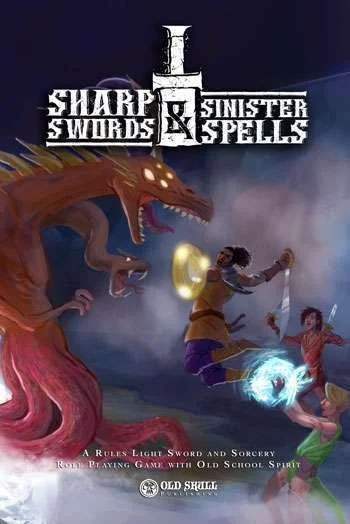
Sharp Swords & Sinister Spells is very up-front about its target: sword & sorcery in the Howard / Leiber / Moorcock lineage, with a rules-light chassis and an emphasis on quick play over “tiresome preparations.” It wants bold protagonists, exciting adventures, and magic that feels dangerous rather than dependable.
That’s already a slight tension with Illmire, which (to me) reads as “muddy hexcrawl pressure-cooker” rather than “pulp episodic romp.” Illmire absolutely supports pulp moments, but the vibe is more: you can win, but you’ll hate how you had to do it.
So I’m reading Sharp Swords as a candidate engine under a specific lens: will it deliver hexcrawl danger, meaningful niches, and GM friendliness… without sliding into either funnel-lethality or weightless competence?
The core mechanic: roll-under, with opposition baked in
Most actions are Attribute Tests: roll a d20 and succeed if the result is equal to or under the relevant attribute. Difficulty is handled by modifiers (±1 to ±10), and the text is clear about using that scale to express how hard something should feel.
Where it gets interesting is how opposition is handled. NPCs and monsters often roll in the opposite direction, aiming to roll high enough to beat your attribute or your result. It keeps the whole table in one idiom (d20, roll-under), but gives the GM an “active” tool that feels like a contest rather than a static DC.
Positive and Negative Dice
Instead of stacking modifiers, the game uses Positive Dice and Negative Dice. You roll an extra die (usually another d20). With a Positive Die, the player chooses the better result. With a Negative Die, the GM chooses the result they prefer. It’s fast. It’s legible. It also has the delightful side effect of making danger feel personal: you can watch the GM pick the die that ruins your day.
Pushing rolls
You generally get one attempt. If you want another, you can Push the Roll by narrating extra effort and accepting extra risk. If you still fail, the GM is encouraged to worsen the situation. This is one of those rules that quietly teaches good hexcrawl behaviour: you don’t keep rolling until the lock opens, you decide whether the lock is worth bleeding for.
Usage Die and Luck Die
Resource tracking uses the Usage Die (step-down on 1–2 until depleted), which is fantastic for torches, rations, ammo, and other “slow dread” supplies.
Then there’s Luck, tracked as a die that downgrades on 1–2. You can also burn luck proactively to reroll or secure a favourable outcome, and it refreshes at the end of an adventure.
Luck is thematically perfect for sword & sorcery. For Illmire, I’m more ambivalent: a hexcrawl wants attrition pressure that persists, and “luck resets after the episode” can soften the long, grimy grind unless you, as GM, are disciplined about what “an adventure” means.
Characters: clean structure, light texture
Character creation is 3d6-in-order for Physique, Agility, Intellect, Willpower, then you choose an archetype and a vocation.
Archetypes
There are three archetypes: Warrior, Specialist, Magic User. Archetype gives you Hit Dice, Luck Die, and a small set of special abilities.
This is clean. It’s also where my Illmire concerns begin. Three archetypes is very “broad strokes,” and while you can paint a lot with broad strokes, niche protection starts to depend heavily on table consensus rather than mechanical differentiation.
Vocations
Vocations give you a Positive Die on appropriate tasks, plus some thematically fitting gear. It’s intentionally loose: you’re relying on fictional positioning rather than an exhaustive skill list.
Loose vocations can work brilliantly in play, especially with a group that enjoys negotiating competence in-character. In a hexcrawl, they can also drift into “everyone is broadly competent at everything as long as they can justify it,” which can blur niches unless the GM applies consistent boundaries.
Complications
Complications are the best “story engine” in the character rules: you roll (or pick) a messy personal problem (Debt, Hunted, Enemy, Addiction, etc.), and once per adventure you can trigger it to improve your Luck Die, explicitly inviting the GM to make your life worse later.
This is great for sword & sorcery. For Illmire, it’s great too. Illmire loves consequences, but it’s consequence in a very dramatic register, not necessarily “logistical attrition and mounting dread.” It can absolutely coexist, but it’s a different flavour of pressure.
Combat: fast, swingy, and genuinely dangerous
Initiative is simple (HD order, Agility tests for ties). Attacks are Attribute Tests (melee Physique, ranged Agility), and there are clean rules for range penalties and situational dice.
The GM-friendly scaling rule
The most Illmire-relevant bit is Powerful Enemies: if an opponent has more HD than the character, apply a +1 modifier per extra HD to rolls made for and against that opponent. Tough things hit more and are harder to hit. One rule. Minimal prep overhead. That’s genuinely excellent.
Dying and healing: peril without a funnel, but with scars
At 0 HP, PCs are dying rather than dead. If someone helps within an hour, you can make a Luck Roll to survive. Success brings you back with a small amount of HP and a permanent reduction to Physique or Agility. Failure is death.
This hits the “peril but not funnel” target nicely. It preserves fear while keeping campaigns viable. It also creates a natural arc where characters become more fragile over time, which is very genre-appropriate.
Healing is limited, magical healing is rare, and recovery depends on rests and safe haven time. For hexcrawls, that’s a good baseline: players feel the drain, and the swamp gets to matter.
Magic: powerful, risky, and inclined to cause paperwork with the cosmos
Spellcasting is a Willpower test with Difficulty equal to the spell’s power level, chosen at cast-time. Failure either loses the spell for the day or invites complications. Armour heavier than light makes casting harder.
On a natural 20, you trigger a Spell Catastrophe table that can range from backlash to accidentally summoning a monster.
This is chef’s kiss sword & sorcery design. It keeps magic dramatic and frightening, and it gives the GM permission to make spellcasting feel like a bargain rather than a utility belt.
How this actually plays for Illmire
Illmire is explicitly compatible with B/X-style play and mentions Sharp Swords & Sinister Spells as a supported system.
Mechanically, Sharp Swords will absolutely run a swamp hexcrawl: it has resource pressure (Usage Die), danger pacing (random encounter procedures), morale rules, and combat that resolves quickly.
The sticking point, for what I’m personally looking for, is character build options and niche clarity. The archetype/vocation structure is elegant, but it’s light. If your players are the kind who enjoy feeling distinct because the rules make them distinct, they may find this too airy unless you reinforce it through firm vocation adjudication and strong spotlight discipline. In other words: it can work… but it leans on the table more than the sheet.
Comparisons: Shadowdark, Old School Essentials, Dragonbane
Shadowdark
Shadowdark is OSR spirit with modern handling: d20 + mod vs DC, advantage/disadvantage, slot inventory, and the real-time torch rule that turns exploration into a nervous habit.
It also gives players more “build texture” via talents at level-up. As my main objective is Illmire + clear niches + GM-friendliness, Shadowdark is a very strong contender. It keeps the referee workload low, keeps peril high, and still gives players a sense of differentiated progression.
Old School Essentials
OSE is B/X precision: straightforward procedures, classic exploration/combat rhythm, and (in Advanced) lots of class variety for niche protection.
The downside is lethality and fragility in the traditional sense: 0 HP is death, and the system expects old-school caution and replacement characters as part of the campaign ecology.
OSE is arguably the most “native” fit for Illmire. It’s also the one that most risks pushing me back toward the spare-cousins problem I’m specifically trying to avoid.
Dragonbane
Dragonbane is roll-under skill-based play with Boons/Banes (roll two d20, pick the better/worse), and crit/fumble on 1/20.
It’s excellent for making characters feel competent in specific domains, and it’s generally very pleasant to run. The cost is conversion friction: Illmire assumes B/X-ish rhythms, and while Dragonbane can absolutely do hexcrawls, you’re doing more translation work than with Shadowdark, OSE, or Sharp Swords.
So… is Sharp Swords my Illmire system?
Here’s where I land, with my stated goals: Sharp Swords & Sinister Spells has real merits, especially the GM-friendly monster scaling and the “die but maybe live, permanently worse” safety net that keeps peril meaningful without turning the campaign into a funeral home.
But if the brief is Illmire + strong niche feel + low GM load, I don’t think this is quite the right fit for me. The character build side is just a little too light for the kind of players I often recruit for fantasy roleplaying games, people who want to look at their sheet and see a shape, a role, a reason they matter beyond “I also brought a rope.” This system can deliver that through play culture and adjudication, but it doesn’t hand it to you out of the box.
In practice, that means I’d reach for Shadowdark first if Illmire is the north star: it keeps the OSR ease, pushes exploration pressure hard, and offers more mechanical texture for niches without demanding Pathfinder levels of GM labour.
Sharp Swords, meanwhile, feels like a brilliant engine for the sort of sword & sorcery campaign where you want fast play, dangerous magic, and protagonists who survive by being unlucky in interesting ways. It would work particularly well for a small group of maybe 1 or 2 adventurers (like Fafhrd and the Gray Mouser). I can already picture it running a nasty city-state job, a doomed treasure hunt, or a pulp mini-series where the wizard is one bad die away from inventing a new local legend.
Who is this game for?
If you want sword & sorcery that moves, bites, and doesn’t ask the GM to do unpaid overtime, this is a very good game. It’s for tables that like consequences, that enjoy negotiating competence through fiction, and that want magic to feel like a dangerous shortcut rather than a reliable appliance.
Who is it not for?
If your players want deep character build differentiation, lots of mechanical widgets, and niches that are enforced by the rules rather than the table, this will feel too minimal. If your group wants tactical combat as the main event, it’ll feel swingy and spare. It’s built for decisive moments, hard bargains, and victories that end with someone quietly asking, “Do we still have any clean bandages?”
And if you’re hunting for the perfect Illmire chassis specifically, this is the one I’d recommend reading with a pencil: it’s close, it’s clever, and it’s tempting, but for my tastes, I suspect Shadowdark gets me to the swamp with fewer compromises.