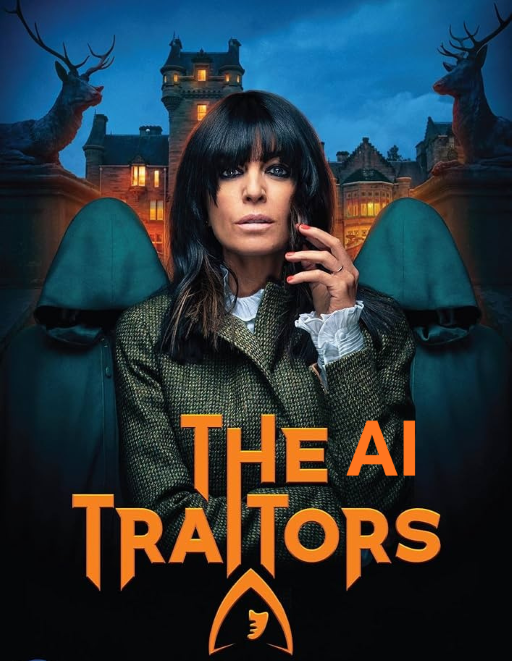
Last night I finished watching the Traitors (UK) – don’t worry, no spoilers ahead. Then this morning I got asked by Thomas at the Rascal whether this blog was AI generated. He has enjoyed my writing but was warned off it by someone else. Besides being chronological events in my life there was something about this I felt worth writing about.
Firstly, for those who are not familiar with the TV show, Traitors is a game where 20 or so contestants work together to build a prize pot whilst eliminating contestants through the process of banishment (a vote) and “murder”. The murders are committed by hidden Traitors and the banishments are designed to get rid of these Traitors before the game ends. If the Traitors survive to the end, they walk away with the prize fund and any surviving Faithful walk away with nothing.
It struck me after I responded to Thomas’s question privately that we were all in a similar situation when it came to AI generated content. For whilst occasionally Traitors reveal themselves by being obvious, more often than not the Faithful banish fellow Faithful with the conviction that comes from millions of years of evolved pattern matching, confirmation and affinity bias. Human beings are in fact pretty good at jumping to conclusions based on little data. And missing the obvious if they’ve already decided they like someone.
In some ways, the question of whether something is AI generated bears the family resemblance of this game. It is complicated by snake oil sales of AI detection tools that give comfort that the genie can be put back in the bottle. That if we apply pattern matching tools to text we can identify the “fake” stuff. But this ignores how those AI generated patterns were formed: from identifying patterns in human generated text. It also ignores the fluidity of human dialogue and how we quickly adopt norms in communication we see exhibited in the world around us. Anyone with children has seen this first hand as they bring memes and “brain rot” home. Even if we’re oblivious of our own memetic mirroring.
Once you suspect a stranger of using AI it is easy to find evidence to support your suspicions. This is especially true if you’re using AI tools yourself a fair bit. We are seeing waves of heuristics asserted as extremely reliable in doing this. Does the writer use m-dashes? Do they have semicolons placed as connecting sentences? Do they use the classic rhetorical style of positing two negatives then a positive assertion (“Not X, Not Y but Z!”)? Does the writing as a whole seem formulaic? Does it use short paragraphs or bullet points too much? Does it seem to not cohere as a whole?
Then either it is one of the published works of writing over the past hundred years; or the massive bulk of text published on the Internet in social media, blogs and forums over the past three decades; or it is AI generated.
As human writing evolves; as these AI models adapt and as new pattern matching formulas and detection heuristics become common wisdom or part of automated detection tools, I expect this list will change.
Yet I’m willing to bet that the sad fact is there is no Shibboleth for identifying human creativity in the medium of text. There is nothing that can prove conclusively you are not a Traitor in this game, More so, and most insidiously, in the real world you never get to stand up and tell the Faithful they’ve made a terrible mistake and banished one of their own.
However, let me not bury the lede. The answer to the question “Is this blog AI generated?” is no*. But those who have read my blog posts or know me from other media, know I love a process story and an opportunity to talk about how I do things. So I’m going to talk about that for the rest of this post. I’m also going to do a very Traitors reveal of a “secret relationship” I have with AI that informs my current thinking around it. In the end I hope you find it interesting.
Even if, at the end, you will never know for certain whether ChatGPT wrote the whole thing. I’m sorry, that’s just the world we live in now.
How I write / How to prove a negative or what I’ll have to look at doing next
There’s three kinds of things written on this blog which I’ll cover in a moment. But it’s worth saying that as well as this blog, I have two other blogs. One where I share my poetry and another where I put non-gaming essays and short stories. You see the thing is I have been blogging for a long time although much of it has been lost in server / domain moves. I was blogging in the first wave of blogging and even got an entry in Wikipedia for a blog related game I built and ran back in those days.
In short, I’ve been writing bad prose and mediocre poetry for a long time. I even thought for a little moment I should learn something formal about it and did a Creative Writing course at the Open University. I even had a few things published. But, I am honest enough with myself to say that whilst I must write, that I cannot stop myself writing, this is never going to be my living. Thankfully it doesn’t need to be to have value for me.
But back to this blog. I seem to have settled on three types of articles, however temporary this arrangement turns out to be. Two were there from the beginning: campaign blogs / after action reports of games I’ve run and advice to fellow gamesmasters.
Last year I added another string to this bow of mine while writing some “quick reviews”. I did this mostly because I found the pile of RPGs on my To Read pile depressing and also, a negative barrier to buying more RPGs. It also made running the games I was running more difficult because I couldn’t commit to a game without thinking about the other games I wanted to run. So to get this all out of my system I decided to read and review these games. I did a couple of initial quick reviews which were rush jobs of writing and then expanded into a structure that I had pretty much repeated with some variation for a few months now.
My process for these different kinds of writing is different. My campaign blogs come from an initial set of notes written after the session as I cannot run a game and keep notes. Then I flower up the prose a bit and fight the “tense demons” (am I writing this from the past or present or what?). These probably take the longest time to actually write and are often much delayed from when the session happens so are probably useless to my players. But they let me use creativity and tell a story which I enjoy.
The gamesmaster advice is often the quickest to write. I typically don’t write these with reference to anything else, at least initially. I just sketch what I do and what I have learned in short, terse prose then move pieces around so the structure is easier to follow. I typically do this all in one sitting. Then sometimes I think, “Maybe somebody has already written about this topic” and do some research. If I find something relevant I’ll backfill it into my argument. This is how I did my philosophy papers and I think about this kind of argument-led article in the same way. Get your own thoughts in order and then support it with research. But in this case, I just don’t agonise about it in the same way as the academic papers I wrote. This is a games blog, not my masters thesis.
Then there are the reviews. They don’t take as long as the campaign blogs to write but they are not one and done like the advice posts. I have to read the thing and try to summarise it as if I would be explaining it to my players should I wish to run it. Which means I have to understand what the thing is. I do this with the usage of copious amounts of posts-its stuck in books. If I can’t explain the core mechanic in a post-it or two I probably haven’t got it. Then I do an outline of the article and here the structure I’ve settled on gives me a layout of what to contain in the review. Once I’ve got enough flesh on it that it all makes sense to me, I leave it a day or two. I need the distance from it to look at it from someone who doesn’t have the game in their head. Then I come back and write it all out in fuller prose. I insert dumb jokes. I make stupid analogies. I expand on stuff and maybe rant a bit. When it feels too long but covers everything I need, I leave it another day. Finally, I come at it with a spelling and grammar checker. I often cut stuff which are too tangential to be worth the reader’s time. Before I doubt the value of the whole thing, or let’s be honest at the moment that doubt is reaching its climax, I publish it and try not to look at it again besides sharing it on a few channels.
Most of the time my only writing tool is Sublime – a text editor I’ve loved for years. I’ve tried other tools but what I need is something simple that just saves my work even if I forget to. And very importantly, something that works offline. Because I know this about myself: I am a very online person. My brain is like a hamster in a wheel when the Internet is available. If I want to write or read, I have to put myself into a metaphorical Faraday Cage where I cannot be distracted. I put my phone in a different room. I turn off my local wifi booster in the office at the switch. If I want to look for something online I have to physically get up and turn things on and wait. There are no quick fixes of Internet dopamine when I’m trying to be productive. It works for me – most of the time. If I’ve slept enough and haven’t got too much caffeine in my system. I think that writing is part of my solution to get away from the Internet anxiety cycles that I’m addicted to.
Going forward, as these questions about my human-ness come up, I may need to do things differently. I may need to integrate a version control system into my writing process. To prove I laboured over this fairly mediocre stuff I write; that few people will ever read. It may be bad and stink but godammit it’s my bad stink and maybe I need the receipts to prove it.
Yes, this is all very self-indulgent but I guess that just makes me a writer.
But where do I stand on AI?
I can’t leave this topic without saying something about my “secret relationship” with AI. I am hesitant to do so because the discussion online is so polarised and there’s more heat than light in it. Fundamentally, I don’t think people know what they’re objecting to and there’s a big bucket called AI that contains many different things. Only some of those are generative AI (Large Language Models – LLMs). The way some of the prominent LLMs have been built, by sucking in the public Internet, is not different to how search engines have been built. Search engines got a lot of backlash from publishers for similar economic niche protection reasons. There are also parallels with how electronic music (mixology) got trashed in the early days for stealing the hard work of musicians and composers by producing derivative works. But then you may say these things aren’t putting creative people out of work in the numbers that AI is threatening to do. You may be right.
Anyway, this isn’t a blog post to debate these things or try to define what we are objecting to when we object to AI. Or whether this is a Napster moment for writers, artists and musicians (again) or not, I have published some thoughts on this elsewhere.
If I may continue being self-indulgent a bit longer, it’s worth being open about the fact I have a Masters in AI (from back in the late 90s) and more recently did a Masters in Philosophy focused on AI (on whether machines can actually think). I was pursuing doctoral research in the nature of AI until recently. I work in an industry that is being transformed by AI and a small part of the work I do is in applying AI in the public sector.
I am not ambivalent about AI as a whole even if I am by years of training as an engineer both cautiously optimistic of its potential and deeply sceptical about the sales pitch made by the corporations that sell some of the big name AI platforms. I am painfully aware of the double-edged sword nature of the technology. I don’t think it is going away.
When I was doing my doctoral research and teaching undergraduates as part of that, ChatGPT broke out and we were all taken aback by how well it worked. It was possible to get it to write a passing grade essay and because we were all new to it, we worried what this would mean. Some advocated hard lines against it whilst others wondered if we should change the way we measure understanding so it wouldn’t be a hurdle which could be automated away. University administrations have reflected these different approaches. They’ve paid through the nose for AI detection tools that are fundamentally flawed hacks and they’ve allowed undergraduates to use ChatGPT to help them write essays. It’s a mess, it’s a compromise, it’s evolving.
I think in both work and teaching, we have to examine what we value and what these AI tools reveal about what it means to be a human being. We need to make intentional decisions about our relationship with the technologies that shape the world around us. We should advocate for political positions that sometimes make messy compromises in an evolving situation, ensuring technology does not lead to human misery nor do we stifle human ingenuity that could be transformative in a positive way. But again, this isn’t the blog to do that.
Concluding Thoughts
I just don’t think we have an answer to any of this yet. I think the debate online is mostly ill-informed. More so, sadly I don’t think the differing sides are even talking to each other. They’re not even in the same circles. This mirrors other culture war issues. Self-selection of communities and Balkanisation of online populations that breeds hostility of the Other. It’s not a place to have a nuanced discussion about AI. Only absolutist positions get the clicks.
When it comes to my own creative writing, as this blog tries to be, I can only comfort myself by the fact I have a deep desire to write and yes, to be read. I write because when I do I can get away from distractions and I can order my own thoughts.
I am not some ascetic who does not need external validation though. I like it when someone reads what I write and likes it. It validates my little monkey brain. It gives me a reason to keep writing. And it doesn’t take much of that to make me keep writing. Honestly, you don’t write a blog like this when you have zero name recognition nor brand awareness (as the influencers would say) expecting to be fed by the engagement of thousands. But once in a while one of the people I play with or who I interact with on Discord or Bluesky says they like what I wrote – that is catnip to me.
So was this generated by AI? No. Why would I outsource something that gives me pleasure to a machine? I will use AI when it takes away the work I don’t want to do. But writing this? This is what I want the AI to free my time to do!
Thanks for reading this far. This was a rush job and probably should be shorter but I wanted to get back to writing the next Children of Fear campaign blog rather than naval gazing too much longer by editing this properly.
* For full disclosure: There may be images on earlier entries of this blog from some of our game campaigns that were generated by AI. I won’t use that technology here going forward but I don’t want to scrub the past by deleting them now.