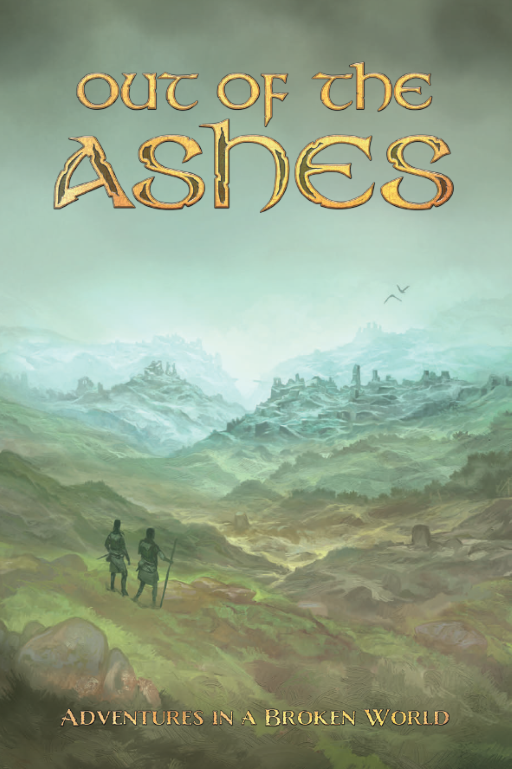
Sometimes I look at my fantasy campaigns and realise we’ve spent several sessions arguing about which direction to march in and about twenty minutes talking about what anyone is actually marching for. We do the epic road trip, we do the last stand on the battlements, and then the curtain falls before anyone has to decide who’s fixing the well or teaching the kids not to poke the cursed monolith.
Out of the Ashes starts where most games would cut to credits. The Nameless Emperor is gone, the Third Age is a smoking write-off, and what you’ve got left is a handful of battered survivors, a valley that’s only mostly tainted, and a vague mandate to “rebuild civilisation” with whoever turns up and doesn’t immediately try to eat you. You’re not legendary heroes so much as very determined community organisers with swords and trauma.
It’s a post-apocalypse that feels uncomfortably appropriate: climate damage baked into the landscape, institutions collapsed, people clinging to small places that still work. But it’s not all doom-scroll misery either. Out of the Ashes is interested in whether you can grow something kind and sustainable in the ruins and what it costs to keep doing that when the easiest solutions tend to look suspiciously like the old empire in new clothes.
It’s important to note that I haven’t run this yet, but I’ve been preparing myself to play in a campaign run by Steve (of the excellent Orlanth Rex’s Gaming Vexes podcast). We’ve already done some collaborative world building on Discord, following the rules provided and our session zero is imminent.
What’s the deal? World, community, and tone
On the surface, Out of the Ashes is a fairly traditional fantasy game. There are cultural archetypes, ruined kingdoms, undead horrors, corrupt sorcerers, and big dangerous monsters you can stab for meaningful numbers of d10s. Underneath, it’s much more about communities, culture, and the slow work of rebuilding than it is about dungeon loot.
The big picture: the Nameless Emperor very nearly won. His Ministers and their forces (tainted humans, undead, and desecrators from outside creation) trashed most of civilisation before being beaten back. The Emperor’s gone, but the Ministers survive in various lairs, and the land is full of scar tissue: tainted swamps, haunted ruins, enslaved peoples, and places where just standing there eats your Spirit.
Your characters all belong to one shared community: a settlement or nomadic group with its own little slice of this broken world. Communities have:
- A concept: “frontier town of mixed refugees,” “hidden Alari city,” a caravan following an old trade route.
- Attributes: Hope, Military, Prosperity, Territory, Education – each tracked with either a flat number or a resource die (d4–d12). Hope is both mood and resilience; Military and Territory tell you how big and defended you are; Prosperity is how rich you are; Education covers expertise and books.
- An army (if Military > 0) with its own size and effect rating for mass combat.
The book gives a fully worked example community, Dassos: a forest outpost turned refugee town, with decent walls and militia, low Education, poor Prosperity, and Hope clinging on at a d4. It’s a neat little bundle of politics, problem NPCs, and nearby horrors.
Around the community, you and the other players define dangerous places (haunted houses, tainted hills, Fortresses of Horrible Things) and threats (winter famine, refugee tensions, invading Ministers, local feuds). Those become the fuel for the campaign. Leave them alone and they escalate, gnawing away at community attributes; confront them and you get quests, scars, and stories.
The tone is explicitly “hope struggling against despair.” Magic is described as echoing the first song of creation: words and music that underlie reality. Art is literally part of how the world works. Sorcery from the void, by contrast, is wrong in a deep, environmental way. Tt corrupts landscapes as much as souls. It’s simultaneously very mythic (immortal Alari, Ministers like fallen angels) and quite grounded, with a lot of attention paid to food, trade routes, and the sheer logistics of surviving another winter.
If you’ve ever wanted to play “the bits between the epic wars” in The One Ring, but with the war already technically over and the immediate stakes being your town’s Hope die, this is firmly in that space.
Characters: cultures, keys, and not becoming a monster
Characters in Out of the Ashes are competent but not superheroic. You build them from a handful of clear elements:
- Culture & Name: Alari sages, forest-dwelling Ekeli, chained Kethians, pragmatic Nisians, proud Vespans, mountain clans, and so on. Each brings a set of assumptions, tensions, and relation to the war.
- Concept: “Roadwarden,” “Widowed Smith,” “Haunted Light-Bringer,” “Nisian Messenger.”
- Focus: describes what you’re best at (Determined, Canny, Reckless), and caps your skills at different levels.
- Skills & Talents: There are fifteen skills split into Physical, Mental, and Social (Athletics, Fight, Shoot, Survival, Lore, Battle, Insight, Persuade, Song, Taunt, etc.). Talents are little special rules exceptions: extra damage, battlefield tricks, magical gifts.
- Keys: your mystical “tuning” to aspects of creation like Storm, Earth, Community, Change. Keys let you do petty magic and serve as gateways into full magical styles.
- Drives: a mix of Duty and Passion statements – “To protect the children of Dassos,” “To see new places,” that sort of thing. These are how you get your mojo back.
- Characteristics: Endurance (how much punishment you can take), Spirit (emotional and spiritual resilience), and Despair (how close you are to becoming tainted).
Spirit is the game’s emotional hit points and meta-currency. You spend it to:
- Add bonus dice to rolls.
- Power your keys and magic.
- Cheat death once per scene, dropping to 1 Endurance instead of dying.
You get Spirit back by hitting your Drives in play, by resting in downtime, or by completely losing control in a scene and gaining Despair. That last route gives you a burst of Spirit, a manifestation of your Despair, and nudges you closer to becoming tainted, the half-monster foot soldiers of the Nameless Emperor’s forces.
I really like this bit. It puts the “grim hero pushing themselves too far” trope directly on the sheet. When things go badly, it’s tempting to reach for Spirit you don’t really have, but each time you do, you move one step closer to becoming the thing you’re fighting. For a table that enjoys slow-burn character drama, that’s gold. For a table that just wants to kick in doors, it may feel punitive.
The core rules: 2d10, resource dice, and failing forward
Underneath the community stuff is a fairly straightforward, modern trad engine. Everything revolves around skill tests:
- Roll 2d10 + relevant skill.
- Compare to a difficulty, usually 15 for standard tasks; 12 for easy; 18 for hard.
- If you meet or beat the difficulty, you succeed; otherwise you fail and something bad or complicated happens.
Opposed tests against NPCs use “10 + their skill” as the effective difficulty, and only the players roll, whether they’re attacking or defending.
There are bonus dice, often a d10, sometimes smaller, for talents, help, or situational advantages. These get added into the pool, and you take the best two dice for your total. If any two dice match on a successful roll, it’s a critical success, which usually means extra damage, more group successes, or a free follow-up action.
The other big mechanical idea is resource dice. Things like Wealth and expedition Supplies aren’t tracked as numbers but as a die type: d4, d6, d8, d10, d12. Spending resources usually means rolling that die and stepping it down: spend d8 Wealth, roll it, drop to d6. If you ever hit zero, you’re out and bad stuff happens. It’s a nice compromise, more tactile than an abstract “Wealth stat,” less fiddly than counting coins or supply ticks.
Combat is opposed rolls all the way down:
- Attacks are Fight (melee) or Shoot (ranged) tests, opposed by the defender’s Fight or Athletics.
- Damage comes from weapon dice, modified by talents and criticals. Armour gives Protection that soaks damage until it runs out for the fight.
- Players can use talents like Charge, Aim, Trick, Taunt, or Morale Attacks to manoeuvre, debuff, or break enemy morale.
There’s an explicit conversation about “failing forward”, if a failed test would stall the plot, you should succeed with complications instead: extra danger, worsened community threat, a bigger bill later. The GM chapter pushes this pretty hard. That lines up nicely with the game’s tone. Failure should bruise your community and your Spirit, not the pacing.
Overall, the engine is more trad-crunchy than something like Mythic Bastionland, but nowhere near GURPS or d20 levels. You’ll roll a fair few dice and track a few numbers, but it’s all in the “adult after-work brain can cope with this” range.
Structures and subsystems: how play actually flows
The bit that really makes Out of the Ashes stand out is the cycle of play. The book is very explicit about how a campaign is meant to go, right down to how it ends.
Quests, downtime, escalation
Play alternates between:
- Quests: classic adventures sparked by threats or dangerous places: rescuing captives from a hollow hill, stopping a new governor from strip-mining your town, exploring a tainted swamp.
- Downtime: healing, pursuing personal projects, advancing the community, doing politics, and watching threats tick up.
After each quest, you:
- Hand out experience, improve characters, and possibly bump up community attributes.
- Roll to see whether threats and dangerous places escalate. Maybe Hope drops, maybe Prosperity takes a hit, maybe that creepy haunted hill turns into a full-blown threat.
- Pick or generate the next quest. Some threats can quietly go away; others will keep growing teeth until you deal with them.
A key point is that the game is designed to be finite. Eventually either:
- Your community prospers, you’ve resolved all the player-generated threats, and the GM throws in a big, final world-shaping quest as a capstone, after which everyone narrates epilogues – or
- The community goes down in tragedy. Hope hits zero, or a critical threat escalates and destroys it and you… still narrate epilogues, just sadder ones.
As someone with more half-finished campaigns than functioning pens, I really appreciate the honesty of that. You are meant to tell the story of one community over a specific arc and then stop, not grind out an endless “season eight” where everyone’s grandchildren are still on the same character sheets.
Expeditions, skirmishes, and mass combat
There are a few dedicated subsystems that support that arc:
- Expeditions handle overland journeys as a series of “legs,” each with a difficulty, a Supplies spend, and potential hazards. Players choose actions per leg. Gather Supplies, Navigate, Stay Alert, Find a Resting Place. Then roll to see how badly the wilderness chews them up. Running out of Supplies means Endurance damage from exhaustion that lingers until you can rest properly.
- Skirmishes are small-scale fights where each character picks from a menu of actions (attack, aim, charge, defend, trick, taunt, morale attack) that give situational benefits. It’s all still 2d10 vs difficulty, but the structure gives you more tactical texture than “I hit it again.”
- Mass combat uses community Military and army stats to resolve big battles (sieges, raids, last stands) without tracking every soldier. It’s not ultra-detailed, but it means when the Ministers send an army, you’ve got something more than vibes to work with.
Downtime, meanwhile, has a buffet of activities: training, working for the community (to earn advancement points), recruiting specialists, forming elite units, combining communities, reaching out to new allies, and so on. You’ll often be spending community attributes like Hope or Education to get things done, which makes those numbers feel genuinely precious.
Magic and Keys
Magic in Out of the Ashes is built around Keys and styles. Each character has one or more Keys, which represent attunement to aspects like Storm, Fire, Community, or Change. Keys on their own let you do little boosts, spend 1 Spirit to add a d4 to a relevant roll, but also qualify you for specific magical styles.
Styles are broad, thematic packages: Light Bringers, Earth magic, Sky magic, the Angry Earth, Rune magic, and so on. Each style has a costed list of effects and talents, from healing and blessings to battlefield magic and big environmental tricks. Overusing magic drains Spirit, and thus risks Despair; the game leans into the idea that power has a psychological cost, not just a mana bar.
Evil beings (tainted, desecrators, Ministers) don’t use these styles. Their powers are expressed as nasty GMC talents like Blight, Aura of Corruption, Ice Magic, Necromancy, and so on, drawing from the void outside creation rather than the first song. It’s all very coherent thematically. Your magic is woven into the world, theirs is a tear in the fabric.
How it reads at the table
On the page, Out of the Ashes feels like a mix of:
The grounded, modern-urban structure of Liminal (Paul Mitchener’s other big game), but transplanted into a post-war fantasy landscape; and
The melancholic, slightly Glorantha-flavoured mythic fantasy you’d expect from the influence list: The One Ring, Symbaroum, Mutant: Year Zero, Legacy, The Quiet Year, and so on.
The GM toolkit is strong. There’s a clear section on themes, guidance on building the community with your players, advice on how to turn dangerous places and threats into quests, and two sample adventures using Dassos. One classic “return to the haunted hollow hill to reclaim tapestries and a legendary spear,” one about resisting soft imperialism from the last big city. Both showcase the politics-and-monsters tone nicely.
Where I think it will really shine is with a group that enjoys:
- Character-driven quests with consequences for the home community.
- Making hard choices about which threats to confront and which to let worsen.
- Watching their town’s Hope die creep up or down over a 10–20 session arc.
Despite its slim size, it is a substantial book, around 250 pages, with a full setting, bestiary, GM advice chapter, and plenty of sidebars. It’s not something I’d hand to a completely new GM and say “improvise away, you’ll be fine.” The structure is there to help you, but you still need to prep quests, track threats, and manage both personal and community-level play. If your ideal evening is grabbing a one-page dungeon and winging it, this will feel like homework. Good homework, but still.
Comparing it to Mythic Bastionland
I’ve promised myself not to compare everything to everything I’ve read recently, so let’s pick one game that genuinely sits in the same rough space.
From my own review pile, Mythic Bastionland is the other game that kept popping into my head. Both are about small communities facing a dangerous, fading world. Both have a strong sense of myth and melancholy. Both can be played as “hopeful knights in a crumbling age.”
But Mythic Bastionland is aggressively light and procedural. It has a minimalist rules engine, fast character creation, and a focus on emergent play from tables and maps. Knights wandering a weird countryside dealing with problems, often without much in the way of long-term community mechanics beyond “you have a stronghold now.”
Out of the Ashes is heavier, more structured, and more emotionally explicit. There are clear community attributes, threats, and downtime activities that put the town mechanically at the centre of the game. There’s a more granular resolution system, travel/exploration rules, and a whole chapter of setting. The explicit Hope vs Despair axis, with Spirit/Despair mechanics pushing character arcs toward burnout, taint, or hard-won resilience.
If your group loves Mythic Bastionland’s ease and doesn’t care about tracking a town’s Prosperity or Hope die, Out of the Ashes could feel fussy. If, however, you read MB and thought, “I want more community stuff, more emotional consequences, and a tiny bit more crunch,” then this scratches that itch.
Criticisms and caveats
I like a lot about Out of the Ashes, but I don’t think it’s an automatic slam-dunk for every table. A few things that give me pause:
The tone is specific. This is not a gonzo, Mad Max, chainsaw-on-a-dragon setting. The focus is on rebuilding, politics, and melancholy hope. If your players want wild post-apocalyptic nonsense or super high fantasy, the Nameless Emperor’s ruined domains may taste a bit sour.
The system sits in a middle crunch zone. It’s crunchier than a lot of modern narrative games but not as crunchy as the big trad behemoths. That’s a sweet spot for me, but it can be an awkward no-man’s land. Too light for people who love intricate builds, too heavy for those who want to handwave most rolls.
The 2d10 benchmarks are on the tough side. A standard difficulty of 15 with starter skills in the 3–5 range means you’ll fail a fair amount, especially once you’re rolling opposed tests vs competent enemies. There are mitigation tools (bonus dice, Spirit spends, Keys, failing forward) but it will feel like a harsh world unless you lean into those options.
It’s asking quite a lot of the GM. Even with the guidance, the GM is still responsible for tracking threats, escalating dangerous places, building quests, managing community attributes, and handling regular scene framing. For many of us that’s part of the fun. For others, it’s a full-time job on top of the actual full-time job.
None of these are fatal flaws, but they’re the reasons I wouldn’t just blindly slot this in front of whichever group happens to be free on a Tuesday. It wants buy-in, and it wants the right kind of energy at the table.
So, who is this for?
If you’ve been following my blog, you’ll know I have a soft spot for melancholic worlds with just enough hope to hurt. Cold City’s post-war spies, Mythic Bastionland’s knights in a dying land, that sort of thing. Out of the Ashes fits very comfortably alongside those.
If you’re a GM who will enjoy this, you probably like the idea of telling one finite story about a specific community and then ending it with an epilogue rather than limping on forever. You will also enjoy both the big-picture stuff (threats, community attributes, politics) and the ground-level play (journeys, skirmishes, moral choices).
And you won’t mind a bit of system – tracking Spirit, Despair, resource dice, and community scores is part of the fun, not a burden. Likewise, you need to be up for a tone that mixes hope, grief, oppression, and small acts of kindness. More “post-war village drama with monsters” than heroic power fantasy.
Given my own tastes, I am looking forward to playing this game and getting into my character.
But if you’re looking for a game you want a pick-up-and-play one-shot game with minimal prep then you can one-shot Out of the Ashes, but you’d be fighting against its intended structure.
Likewise, if your players are mostly here for tactical combat optimisation or crunchy character builds this may not be for you. There’s depth, but it’s not that kind of depth.
If, however, the thought of playing the people who stay after the war, who rebuild walls, negotiate with neighbours, argue about food stores, and still have to go and fight undead in a hollow hill because no one else will, makes something in your heart sit up and nod, Out of the Ashes is very much worth your time.
Just be ready for your community’s Hope die to wobble as much as your own when that escalation roll comes up badly.