There’s a very specific brain-worm that afflicts some of us. The conviction that surely there must be a game out there that does “modern wizards in our world” in a way that clicks with your group. I’m not talking high-concept urban horror and this isn’t about superheroes either. I’m talking about people with rent, phones, and access to actual fireballs.
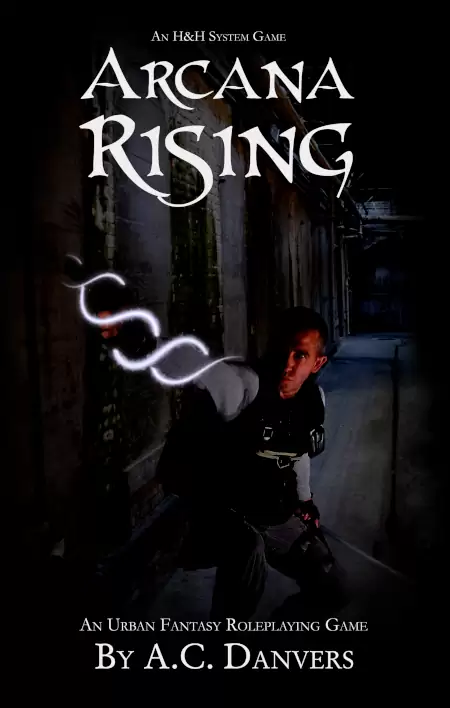
Arcana Rising is from an earlier phase of that search. A moment in the 2010s when the OSR was in full swing, Dresden Files and Buffy were still casting long shadows, and a lot of designers were asking, “What if we just took B/X and pointed it at something other than faux-medieval Europe?” It Kickstarted back in 2013 as “an urban fantasy role-playing game where magic and the supernatural have awakened once more,” powered by the same engine as Hulks & Horrors (remember that?).
On paper it’s exactly my kind of weird. It’s a classic D&D chassis tuned for contemporary cities, with day jobs instead of “backgrounds” and vampires lurking in the suburbs instead of a 10×10 stone corridor. In practice… well, let’s talk about what it actually does, how it does it, and why, despite a lot of things I like, I’m not exactly scrambling to get it on the table. Even so, there is something about this game, which I fear has been forgotten in the glut of games over the past fifteen years, there is something worth looking at here.
OSR in a Hoodie
Arcana Rising is very upfront about its DNA. Under the hood it’s essentially Basic/Expert D&D with a modern reskin and some extra bolts screwed on. Character creation starts with the familiar six stats (STR, DEX, CON, INT, WIS, CHA) rolled 3d6 and assigned as you like.
The twist is that each stat doesn’t just give a single modifier. It feeds into a little web of derived bonuses. Strength affects melee to-hit and damage, Dexterity modifies AC and ranged to-hit, Constitution influences hit points and your Massive Damage threshold, while INT and WIS plug into things like Spell Save, Will/Faith, and magic damage. It’s still recognisably OSR, but the stat table looks a bit busier than your typical retroclone.
Character creation runs through a tidy checklist:
- Roll stats.
- Pick a class.
- Roll hit points and Massive Damage (CON + HD).
- Roll Education.
- Choose a Day Job based on that education.
- Buy gear with three months’ salary.
- If you’re a wizard or cleric, pick spells.
- Optionally add a familiar/animal companion.
- Optionally roll for “Wrinkles” (little background hooks).
It’s still faster than most point-buy systems, but it’s not “5-minute goblin” territory. You’re going to be making a few choices and scanning tables, especially once you get to…
Degrees, Day Jobs, and the Demands of a Mundane Life
The bit of Arcana Rising that feels most “modern” is the education and day job subsystem. Instead of a single background tag, you roll for your Education level (Uneducated, Basic, Collegiate, or Graduate) which unlocks a menu of possible jobs. Each tier gives you some free skill picks to represent that schooling: weapon proficiencies plus bonuses in things like Arcana, Streetwise, Driving, Medicine, Bureaucracy, and so on.
Then you choose an actual Day Job, which does three things:
- It gives you more skill bonuses.
- It sets your monthly Income in Astra (the setting’s currency).
- It sets a Demand rating: how much the job eats your time and attention.
Jobs are nice and flavourful. At the “Basic” level, you might be a Constable, Detective, Forester, Technician, or Writer. At the Graduate level you can be an Academic, Doctor, Lawyer, or Scientist, which come with chunky skill arrays and decent pay. Or you can be a Criminal or Performer from the Uneducated list and lean into that “dodgy mage who knows a guy” vibe.
Demand is what stops this being pure colour. Whenever your supernatural shenanigans collide with your work life, you roll against the job’s Demand to see whether you keep it. Fail often enough as a Soldier and you risk legal trouble and disciplinary hearings. Fail as a Criminal and you may run afoul of the law. Lose the job and suddenly you’re rolling weekly INT checks just to keep a roof over your head and food on the table.
It’s a clever, OSR-ish way of modelling the “I have to be at my shift in the morning” problems that Buffy, Dresden and their ilk constantly juggle. You can absolutely run a game that’s just, “You all work at the same hospital and sometimes there are demons,” and the system will mechanically care that you’re missing night shifts.
Skills themselves are broad, additive bonuses you tack onto stat checks where appropriate. Stealth +2 can help you sneak, spot ambush points, or plan an infiltration route, as long as the GM agrees it makes sense. It’s a nice middle ground: more granularity than pure “roll under stat,” but without building a whole subsystem for every niche.
Classes in Jeans and Leather Jackets
On top of all that street-level mundanity, you’ve got seven core classes, all familiar silhouettes with a modern twist: Gunfighter, Gladiator, Rogue, Wizard, Cleric, Champion, and Forestwalker. Each has level-based hit dice, separate melee and ranged to-hit progressions, and a small suite of special abilities.
The Gladiator is the classic martial bruiser reimagined as everything from a historical re-enactor to an eccentric millionaire who actually knows how to use that wall of swords. They get Against All Odds, which improves their AC as more enemies pile into melee (they thrive in the scrum), Bare Knuckles for better unarmed damage, and Snicker-Snack, which unlocks extra attacks as they level up.
The Gunfighter is your modern action hero: dual-wielding pistols, long arms, and even heavy weapons. Their signature Guns Akimbo lets them fire two one-handed guns per round with no penalty; at higher levels that becomes two shots per gun in a round. It’s very “John Woo by way of OSR,” which is not a phrase I knew I wanted until now.
The Cleric and Champion fill the “people of faith who hit things” niche. Clerics are WIS-based miracle workers whose prayers scale in number and level as they go, with class abilities like Power of Prayer, Fear No Evil, and Holy Vigilance that let them shrug off fear, detect unholy beings, and call down genuine miracles. Champions are the more overt paladins, with holy weapons and an inability to back down from capital-E Evil.
My favourite, conceptually, is the Forestwalker, which reads like a mash-up of ranger and druid filtered through a nature-spirit lens. You pick an animal patron like Bear, Cat, Tiger, Turtle, or Wolf, and each grants a different set of bonuses: Bear toughens you up and improves your unarmed strikes, Cat makes your blades hurt over time, Tiger specialises in stealth and sneak attacks, Turtle rewards patience with bonus damage if you act late in the round, and Wolf turns you into a pack fighter who amplifies allies’ attacks. It’s a nicely evocative bit of design.
None of this is mechanically wild if you’ve played any pre-3E D&D, but it’s all competently done and leans into the fiction in a way I appreciate. You’re not just “Fighter with Guns.” You feel like someone who’s spent years in MMA gyms or police ranges or fencing clubs.
Magic from Lake Vostok
The big setting conceit is that generations ago, the source of all raw magic, the “Great Wellspring”, was sealed under the ice of Antarctica to prevent an apocalyptic magical cataclysm.For millennia, magic dried up; a few hedge wizards, dark cults, and desperate ritualists squeezed out minor effects, but the world was effectively in an “Intermagica,” a magical dark age.
Then the climate warmed, human technology advanced, and a Russian research project finally breached the ancient seal beneath Lake Vostok. Oops. Magic starts flooding back into the world, ley lines uncurl, old prophecies stir, and all the things that fled to the outer planes while the power was gone (fae courts, demon lords, cat siths, Olympic exiles) begin to nose their way back into the material realm.
Mechanically, magic is classic Vancian-ish fare, split cleanly into wizard spells and cleric prayers up to 6th level. Wizards learn spells into a spellbook and memorise a subset each day; clerics get a table of prayers known and “Faith” points tracking what they can cast. Spellcasting relies on INT, WIS, and the Arcana or Religion skills in various ways, with Spell Save and Magic Damage modifiers derived from your stats.
One interesting choice: spell damage is deliberately toned down compared to some D&D variants, and the book explicitly cautions you to scale back imported spells accordingly. Wizards don’t dominate encounters by dropping buckets of dice. They’re powerful, but more in line with everyone else.
It’s all very functional. If you’ve ever thought, “I want to run Buffy with a D&D wizard and cleric,” this will feel extremely straightforward. There aren’t bespoke move-like structures tying magic to social consequences. It’s still “pick a spell, roll some dice.” Whether that’s a feature or a bug depends on how allergic you are to spell lists.
Monsters, Planes, and What You Actually Do
The cosmology is gloriously kitchen-sink. The return of magic weakens the barriers between Earth and the outer planes, leading to a bestiary full of things that feel half folklore compendium, half Monster Manual remix. Cat Siths that eat souls and can be placated with gifts. Centaurs exiled to the plane of Fire. Onachus, bison-things that burn the ground to ash before eating it. Elementals with specific secondary effects based on their element. Elves and valkyries as planar powers in their own right.
Monsters use a streamlined stat block: Hit Dice, Massive Damage, a single To-Hit bonus, TAAC0 (an inverted THAC0), AC, Initiative, Save, attacks, and Morale. It’s very runnable at the table, and the explicit aim is compatibility with other OSR material. You can yoink monsters and dungeons from your favourite retroclone with minimal fuss.
What do player characters actually do? The GM section pitches play firmly in the “urban fantasy procedural” space. Buffy’s Scooby Gang, Harry Dresden, Indiana Jones with a smartphone. The advice is to create a city, stock it with factions and supernatural threats, and then throw situations at the PCs rather than scripting a plot for them to obediently follow. There’s a strong emphasis on “living settings”, NPCs with agendas, factions ticking along whether or not the players get involved, ongoing threats that escalate if ignored.
To help with this, there’s a chunky chapter of genre packages that tweak assumptions and optional rules to emulate different styles:
- Britney the Demon-Slayer gives you a Chosen One plus a gang of Normal People with “plot points” to tweak rolls.
- Call of Leviathan bolts on sanity rules and removes the paladin-equivalents for a Lovecraft-ish tone.
- Catacombs and Chimeras dials the clock all the way back to pure fantasy.
- Delta Arcana presumes everyone’s playing magical special forces.
- Grand Theft Grimoire is about magically-empowered street gangs.
Again, it’s all very toolbox-y. The book doesn’t give you a big flagship city or a multi-part campaign; it gives you knobs to turn and says, “Off you go. Build the version of magical Earth that you actually want.”
The XP rules nudge you towards classic OSR motivations: defeating monsters, resolving major threats, recovering significant magical artifacts. With optional bonuses for hitting character goals or leaning into your personal “Wrinkles.” o you end up with something that plays like a modern-day dungeon-crawl / case-of-the-week hybrid. Track down the basilisk in the botanical gardens, negotiate with the sidhe hedge-fund manager, squeeze in your shift at Tesco.
Shadowrun Without the Spreadsheet (Mostly)
I should confess I am endlessly fascinated by Shadowrun. Every so often I get the urge to throw together a team of street samurai, deckers, and mages to knock over a corporate arcology. Then I remember that actually running Shadowrun means learning several mini-games at once and my soul quietly lies down in traffic.
Arcana Rising is obviously not cyberpunk. There are no megacorps, no Matrix, no chrome, but it does sit in the same broad “magic in the modern world” bucket as fantasy-first Shadowrun. So how do they stack up?
In terms of theme, Shadowrun is about class struggle, corporate heists and the collision of magic with late capitalism. Arcana Rising is more “magic returns to broadly-recognisable Earth and makes a mess.” It wants you thinking about demons in the suburbs, vampire landlords, and Russian research programs accidentally unsealing cosmological mistakes. It’s much closer to Buffy, Dresden Files, and the urban fantasy fiction I talked about in my Gothic feelings post than to Neuromancer or Snow Crash.
On the mechanical side, Arcana Rising is drastically simpler. No dice pools, no distinct subsystems for hacking vs. magic vs. rigging; it’s d20s to hit, d20s for saves, and stat checks with skill bonuses layered on. If you can run B/X or Labyrinth Lord, you can run this. Combat is still fairly crunchy in an old-school way (hit points, AC, Massive Damage thresholds, class-based attack progressions but it’s one coherent system rather than several loosely related ones.
Where Shadowrun gives you a very strong setting out of the box, decades of lore, detailed maps, endless gear lists, and published adventures, Arcana Rising gives you a framework: here’s how magic came back, here’s a planar cosmology, here’s a bestiary, here’s advice on building a city and its factions. It’s simultaneously freeing and a little underwhelming. If “reading the setting chapter” is a big part of why you pick up games, Shadowrun is still going to be more satisfying as a book to chew on.
So why would I reach for Arcana Rising instead of Shadowrun?
Because sometimes I want “modern magic adventure” without the gear porn and subsystems. Because I’d like to be able to borrow monsters and modules from my existing OSR collection instead of learning a whole new mechanical language. Because I enjoy the idea of playing an overworked Detective-Wizard trying not to get fired for missing yet another shift to fight a cat sith.
But if what you love about Shadowrun is specifically the cyberpunk (the decking, the chrome, the moral muck of corporate mercenary life) Arcana Rising isn’t going to scratch that itch. It’s a fantasy game wearing a modern hoodie, not a cyberpunk game with spell slots.
Does It Actually Rise, or Just Idle on the Hard Drive?
This is where I have to be honest with myself as well as you.
There’s a lot I like here. The day job system is an elegant way of making the mundane matter. The genre packages are fun little prompts. The bestiary is packed with planar weirdness that would happily slot into any number of campaigns. And as a free / pay-what-you-want OSR game, it punches above its weight in sheer volume of usable material.
What Arcana Rising doesn’t have, for me, is a killer hook.
The core premise – “magic comes back to modern Earth, have adventures” – is solid but very familiar in 2026. The implementation leans heavily on D&D-style classes and spell lists, which are competently executed but not especially surprising. The setting advice is good, but stops at “here’s how to build your own city” rather than giving you a distinctive example city or campaign spine to steal.
It also lives in an awkward middle ground of complexity. On the one hand, it’s much lighter than something like Shadowrun. On the other, it’s a 270-ish page book with a fairly dense layout, a bunch of derived stat modifiers, and multiple sub-systems (skills, jobs, companions, Wrinkles, optional injury and sanity rules, genre dials). It’s not the kind of thing I can teach in fifteen minutes at a convention to a table of tired strangers, nor is it the glittering crown jewel that makes me want to clear a year for a dedicated campaign.
Given the stack of urban fantasy games already competing for my attention, from story-forward stuff like Monster of the Week and Urban Shadows to bespoke British weirdness like Liminal, Arcana Rising ends up in that increasingly crowded “interesting read, might steal bits, probably won’t actually run” category.
Future Me, if you’re reading this: this is the bit you skim before you buy another urban fantasy PDF.
Who Arcana Rising Is (Not) For
If your happy place is “OSR, but make it modern,” Arcana Rising is absolutely worth a look. It’s for GMs who like building their own cities and factions, who are comfortable hacking old D&D modules into new shapes, and who want to run Buffy-or-Dresden-style adventures without adopting a whole new narrative system. It’s particularly appealing if your group already understands B/X-ish combat and saving throws; you can reskin goblins into hedge-fae and keep rolling.
If your tastes are anything like mine, what you’ll get out of it is a handful of very stealable ideas. I can see myself lifting the day job Demand mechanic for other modern games where I want “mundane life vs. weirdness” to have teeth. I’ll probably raid the bestiary for planar oddities, and the genre packages are ripe for re-use as campaign pitches (“Delta Arcana” would make a great short campaign with almost any rules set).
It is not for you if you want something you can throw in front of a group next week with minimal prep and a very specific tone baked in. It asks you to do a fair bit of lifting: building the city, calibrating the genre dials, deciding what flavour of urban fantasy you’re actually running.
It’s also not for you if what you’re chasing is the crunchy satisfaction of Shadowrun’s gear spreadsheets and elaborate subsystems. Arcana Rising has no interest in that kind of granularity. And if you’ve moved firmly into the “simple mechanics, heavy on feelings and relationships” camp, the Gothic feelings, urban nightmare end of the spectrum, this is going to feel, well, a bit trad.
For me personally, Arcana Rising is going to stay in the “interesting sidebar” section of the collection rather than graduating to the active roster. I’m glad I read it, I’ll happily cannibalise pieces of it, but I can’t quite imagine announcing on my Discord, “Right, this is the one, we’re doing a full campaign of this.”
If you’re a GM with an OSR brain, a love of urban fantasy, and a willingness to do some world-building, though, there’s a genuinely solid game here: a modern magic toolkit that wants you to write your own show, not just watch someone else’s. Whether that’s enough to make it your last best hope for fireballs in South London is, as ever, between you and your hard drive.