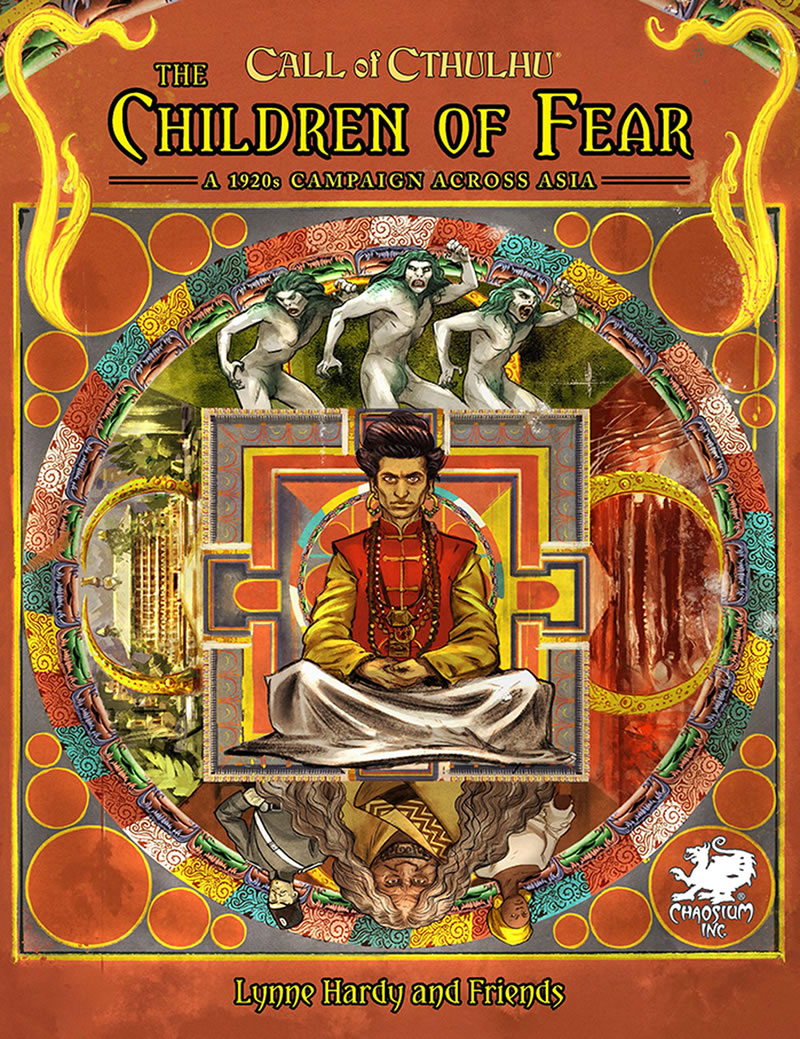
For readers of the Children of Fear campaign, here is a short profile of the investigators introduced so far. The campaign uses both Open Table and Troupe play so the number of player characters is probably larger than most campaigns. Hopefully, this serves as a useful guide for those following along the story.
Miriam Ashcroft
Occultist Scholar
Miriam has the composed, deliberate presence of someone who’s never without a pen and never far from a conclusion. She keeps her brown hair neatly set, wears round spectacles that make her gaze feel even steadier, and dresses in travel-worn layers softened by a scarf, practical, unobtrusive, and quietly expensive in that academic way. When she’s holding an old book, she looks like she belongs in a candlelit side-chapel or a museum archive; when she’s holding a bill or a telegram, she looks like she could make a customs officer apologise.
In the story so far she’s been the expedition’s anchor. Correcting hotel managers without raising her voice, spotting patterns in small events, and taking notes as if the act of recording is a kind of warding charm. London-born and in her thirties, Miriam’s strengths lean toward anthropology, history, and the occult, with a sharp eye for the details other people miss and a persuasive calm that can defuse trouble before it flares.
Wei Gao
Legation Constable (Peking)
Wei Gao is sharply dressed in the way policemen are when they want you to remember they’re official. Even when seated in a rickshaw, he looks composed. Hair neat, suit clean, eyes flicking sideways as if he’s tracking the street without letting the street track him. He has the air of someone who knows exactly which rules can bend and which ones will break you.
Wei joined the expedition as a “secondment,” paperwork smoothed by Midnight Society influence, and he’s been invaluable in the most unromantic ways: acquiring a dignitary’s Chrysler, sending notices along the route, learning from desk sergeants what kinds of bandits and fake toll agents infest the road to Sian, and reminding everyone that corrupt soldiers can often be cowed by the right letter. So long as the letter is real. He persuades when he must, drives when he can, and carries law the way other people carry a weapon.
Marcy Holmes
Socialite and Journalist
Marcy moves like someone who expects doors to open. Even rain-soaked and travel-worn, she keeps a sense of polish. Bobbed hair, sharp eyes, a look that can turn from friendly to probing in a heartbeat. There’s often a half-smile hovering on her face, as if she’s already writing the headline and deciding who looks best in it.
Marcy is the expedition’s forward momentum in conversation. When Aiko begins a respectful introduction, Marcy is the one who steps in and tries to steer the whole exchange. When someone suggests waiting, she’s the one most likely to ask the next uncomfortable question. She’s socially deft, quick to charm, and the most willing to push into other people’s business. Particularly when there’s a story hiding under etiquette.
Zahra Jahan
The Disguise Artist (aka Ravi,” Batu Sarnai”)
Zahra rarely appears as herself. She has appeared as “Ravi,” a young Indian princeling in an immaculate turban; as Batu Sarnai, a Mongolian groom who can vanish into Silk Road traffic like a raindrop in a gutter. In those guises she reads as slight and youthful, wrapped in layered cloth and travel-stained scarves, with dark, watchful eyes that never quite stop measuring exits and angles.
What makes Zahra dangerous isn’t bravado, it’s control. She slips into roles that people don’t question, and that’s the point: no one looks twice at a teenage porter, or a rich foreign child with a guardian, until it’s too late. On the road she’s been the group’s shadow work. Talking to street children, chasing thieves through alleyways, sitting still for hours to outwait someone hiding, and proposing traps that rely on sentiment rather than money. Her social style is charm when she wants it to be, but her real expertise is disguise and stealth, backed by quick reflexes and a talent for spotting what’s out of place, especially when she feels that persistent, maddening sense of being watched.
An Jinqiang
Retired Imperial Guard
An has the kind of face that looks calm even when it isn’t. Close-cropped hair, clean lines, high collar. NHe reads disciplined, contained, hard to rattle. He doesn’t perform leadership, but it keeps finding him anyway. Soldiers who don’t know him listen when he speaks; drivers fall into step; crowds make space.
So far An has been the expedition’s spine. When a convoy wheel sinks into mud, he’s the one who gets boots moving and ropes pulled without making a show of it. He is also the one who has been singled out by the story itself. The lotus-stamped message delivered to him alone in Chengchow, as if someone, or something, had already decided he mattered. His skills lean toward forgery and weapons, but his real signature is that quiet authority that makes people obey before they’ve even decided they trust him.
Kenji Kano
Japanese Scholar and Martial Artist
Kenji’s first impression is still one of contained attention. Young, calm, intelligent-looking, the sort of man who can observe a room for ten minutes and then join a table as if he’s always belonged there. He’s a judoka and educator, which shows in the way he moves, stillness with readiness behind it.
In the early part of the story Kenji’s practical contribution was simple and telling: he had the car, he saw the suspicious watcher in the crowd, and he remembered. He’s the kind of investigator who doesn’t raise his voice or take up space, but whose presence changes how safe everyone feels moving through the world. When fists and politics start to matter more than polite introductions, Kenji will matter more than anyone wants to admit.
Xie “Lee” Liling
Peking Native, Berlin-Trained Researcher
Lee carries herself with a quiet exactness, as if she’s learned to keep her emotions behind her teeth. In the way she’s been presented so far, neat hair, high collar, steady eyes, she has the look of someone who has spent a lot of time being assessed and has learned how to give away very little. She belongs in a city. Poised, alert, and hard to surprise.
Lee’s value on the expedition has been less about being the loudest voice and more about being the most grounded one. She speaks the language, hears the side conversations, and catches the small cultural tells that foreigners miss. When others reach for supernatural explanations, Lee often reaches for psychology and memory first. Skeptical, disciplined, unwilling to inflate a mystery without evidence. Her strengths sit in reading people, persuading when necessary, and listening carefully enough to hear what’s not being said.
Peter Long
Scholar of the Silk Road
Peter looks like the kind of man who can talk his way into a library that doesn’t want him and out of trouble he didn’t mean to cause. He’s short, sharply dressed in a tailored suit, cigarette always close to hand, with a pocket-watch chain that suggests both punctuality and taste. His English is flawless, the sort of fluency that makes foreigners forget how much work it takes.
Peter joined at breakfast and immediately made the expedition feel more real by putting history back into it: the Thousand Buddha Caves as monastery, as contested prize, as a wound repeatedly reopened by foreign expeditions. He doesn’t advertise himself as charismatic, but he has the quiet confidence of someone who knows the subject better than anyone else at the table. When the group needs context, dynasties, routes, colonial rivalries, the politics of “preservation”, Peter is the one who can supply it without romanticising it.
Joe Morton
Reporter
Joe has the lean, hard outline of a man built for cities and deadlines: aquiline nose, suit that’s seen too many late nights, fedora brim shading a direct stare, cigarette smoke like punctuation. He looks like he belongs in the back of a newsroom or under a streetlamp in the rain, notebook in one hand and questions in the other.
On the road Joe is less mystic and more method. He tries to defuse danger socially rather than confront it head-on, and he watches people the way a reporter watches sources, reading what they refuse, not just what they say. He practices photography in the long hours between stops, helps others think about body language and reactions, and keeps his own nerves in check by staying busy. He’s persuasive when he needs to be, strong in library research and observation, and unusually useful on this expedition because he speaks both Hindi and Chinese.
Aiko Tanaka
Anthropology Student
Aiko is the kind of scholar who looks ready for the field. She travels in a broad-brimmed hat and practical coat, notebook always in hand, a camera riding her chest like a second heartbeat. There’s an openness to her expression, often warm, sometimes uncertain, that makes her seem approachable, even when she’s quietly assessing power dynamics the way someone trained in culture and hierarchy does.
Sent by Professor Wang as part of her studies, Aiko arrived careful with introductions and precise with manners, the bridge between academic respectability and the messy work of the road. She’s polite but not passive: she was the one who leaned in when a handcart of “religious tokens” displayed coins that looked a little too familiar, and she’s been consistently thoughtful about what should be taken seriously and what should be left alone. Her expertise is anthropology and mythology, and her social style leans toward charm.
Fred Wiederstein
Soldier Out of Place
Fred is hard to miss. He carries himself like an officer even when he’s trying not to, tall and broad-shouldered, the kind of man whose silhouette is always “uniform” whether he’s wearing one or not. In the images and impressions so far he reads weathered, moustached, hat brim low, eyes that have seen heat and dust and kept going anyway.
In the narrative he arrived at the Hotel des Wagons-Lit in dress blues with a sabre and an ornate pocket watch he fidgets with when the world starts to tilt. That little gesture has become one of his defining tells: the insistence that time, order, and routine still matter, even when rats pour over a desert horizon in a vision that feels like memory. Fred isn’t a talker, and he doesn’t try to be. His competence is physical and practical, pistol and blade, first aid, the steady presence of someone who can hold a line when everyone else is thinking too hard.
Comments
2 responses to “Children of Fear: Who’s Who in the Midnight Society Expedition”
Great stuff.
I heard that this campaign involve a lot of magic, so do you have the Grand Grimoire?
I do but I don’t think it’s needed for the campaign. Enough in the campaign book to do what you need along with the Keeper’s Rulebook.