There’s something distinctly British about imagining the end of the world and immediately worrying about the paperwork. For many of the generation before mine, the formative apocalypse diet was Threads, grim BBC docudramas, and public-information films that strongly implied your best defence against nuclear fire was a kitchen door and a tin of emulsion. Reading Hot War feels like someone took that cultural anxiety, added border-science monsters, and then asked: “Right. Who’s actually going to write the report on this?”
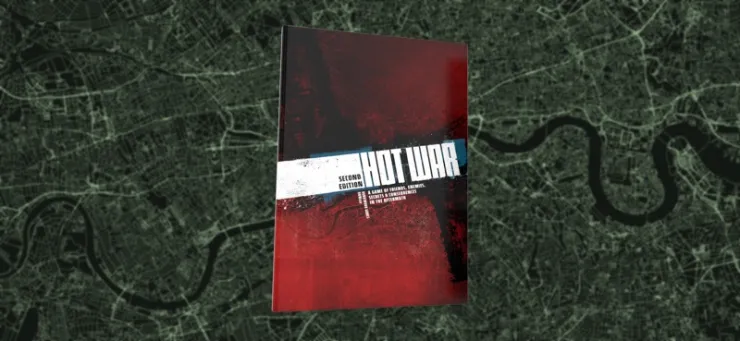
Hot War Second Edition is a post-apocalyptic Cold War horror game from Handiwork Games, a spiritual sequel to Cold City that moves the action from 1950s Berlin to a ruined, burning London in 1963, after the Cold War went very hot indeed. Nuclear weapons were used. So were stranger things. The result is a capital city half rubble, half refugee camp, with a thin layer of British bureaucracy smeared over the top like cold gravy. You play SIG operatives (members of the Scientific Investigations Group) trying to keep a lid on border-science horrors, foreign incursions, and your own factional agendas, while everything is visibly coming apart.
These days it’s hard to open a news site without tripping over some flavour of slow disaster. Rolling climate emergencies, sabre-rattling between nuclear states, public services creaking like they’re held together with duct tape and nostalgia. Dropping into a game where you’re trudging through the aftermath, trying to keep a few small things from unravelling completely while the big picture is clearly beyond you, doesn’t feel like escapism so much as turning the volume up on the background hum we’re already living with.
So, why play a game like this with all that going on in the world? Because in a weird way, playing through a fictional collapse where ordinary people still make hard, decent choices can be a rehearsal for hope. A way to poke at the fear, name it, and remind ourselves that solidarity and small acts of courage still matter, even when the big picture looks utterly bleak. Or at least that’s something to tell yourself while rolling dice in a ruined London bunker on a Thursday night.
Cold City’s War Went Hot
If you’ve read or played Cold City, the earlier “monster-hunting in divided Berlin” game by the same designer, you’ll recognise the bones of the system and even some of the fictional history. Cold City deals with the early Cold War, as multinational teams hunt the remnants of Nazi border science in a Berlin carved into sectors. I described it on the blog as a compact, relationship-driven horror engine with just enough grit to feel grounded.
Hot War asks a very simple, horrible question: what if everyone failed? Same secret weapons programmes, same border-science, same paranoia but this time the nukes and the weird science were used. The “war nobody wanted” has left Britain half-destroyed and politically feral, and London, already a Cold War target in our world, is now a focal point for occupation, refugees, monsters, and internal power struggles. The book gives you a rough sequence of events, lots of evocative vignettes and debrief reports, and then explicitly tells you the history is there to be remixed at the table rather than treated as canon.
There’s also a strong (and very British) focus on places: rotor bunkers, seaforts, the Post Office Railway, subterranean tunnels, airfields, research establishments. The text openly points you at real-world Cold War infrastructure and folds it into the fiction.
The Rules: Dice, Agendas, and Fallout
Mechanically, Hot War runs on a tight d10 conflict engine that lives squarely in that “narrative trad” space. Clear stats on the sheet, but everything aimed at pushing character change and messy fallout rather than fine-grained tactics.
Characters are built from four main elements: Attributes, Traits, Hidden Agendas, and Relationships.
Attributes are Action, Influence, and Reason, each rated from 1 to 5. Action is physical capability and sheer bloody-mindedness. Influence is social pressure, rank, reputation and charisma. Reason is intellect, knowledge, and experience. You start with a point in each and then spread five extra points around, so you can build a very focused specialist or a more broadly competent operative.
Traits are free-form tags like “Former National Serviceman”, “Seen Too Much”, “Radio Ham”, “Always in Debt”, or “Naive and Inexperienced”. You begin with three Positive Traits and two Negative ones. Traits cover skills, personality quirks, traumas, and oddities, and they’re deliberately double-edged. A Trait is both a way to grab more dice and a big sign saying “please mess with this during Consequences.”
Hidden Agendas are the big engine. Every character has a Factional Agenda (orders or goals handed down from some organisation) and a Personal Agenda, which is what you secretly care about. Each Agenda gets a rating of 3, 5, or 9, which is a rough measure of how significant and long-running that arc will be. When an Agenda is clearly in play in a conflict, you double the relevant Attribute and add extra dice based on the Agenda’s rating. Following your obsessions makes you mechanically stronger and drags you deeper into trouble at the same time.
Relationships connect you to other PCs, factions, and important NPCs, with a positive or negative rating. You might start with a +3 Relationship with a fellow SIG officer you trust implicitly, or a –2 with a rival section chief. When a Relationship is meaningfully involved in a conflict, you can pull in extra dice equal to its rating. The rules also give some teeth to who gets to invoke a Relationship first and what happens when you both care, which encourages everyone to weaponise their messy emotional ties.
Once characters are built, including a pre-war “Experience Scene” that both establishes something about the conflict and adds another Trait, play revolves around scenes and conflicts. When nothing important is at stake, you just free-roleplay. When something truly matters, you move into a formal conflict.
The conflict procedure goes like this. First, everyone involved sets explicit goals: what they hope to achieve in this moment, whether that’s driving a monster back into a tunnel, convincing a colonel to evacuate refugees, or proving to yourself you’re not a coward. Then you build dice pools. You pick an Attribute that suits what you’re doing. If a Hidden Agenda is clearly driving your actions, you double that Attribute and add more dice according to the Agenda’s rating. You add two dice for every relevant Trait, whether it’s Positive or Negative, and potentially pull in one of your Relationships to gain extra dice equal to its score. Any tools, weapons, or weird science that meaningfully helps you can add dice as well.
Negative Traits use different-coloured dice, which is important because if a Negative Trait die is the highest in your pool, something bad happens to you related to that Trait, even if you win the conflict overall. “Reckless Glory-Hound” might get you the victory you were after and a disciplinary hearing for disobeying direct orders.
The GM role, here called Control, assembles an opposition pool using “Groups” of dice. Each Group represents a source of opposition: the creature itself, a hostile faction, the sheer difficulty of the environment. Control has a choice: they can “Make it Easy”, deliberately pulling their punches to let the characters succeed but boosting the Groups for later; they can “Make it Hard”, running the conflict normally; or they can “Make it Complicated”, dragging in extra dice from the Breakdown Group, which represents societal collapse and background badness in exchange for more explosive, unpredictable outcomes.
Everyone rolls. The highest single die wins. Ties go to whoever has more dice showing that highest number. Any remaining dice higher than the loser’s best are successes that can be spent on Consequences. Any remaining dice that match across sides become matches, which the loser can still spend on their own fallout.
Consequences are the heart of the system. The winner spends their successes, the loser spends their matches, and both sides are altering the fiction via the character sheet. You can boost or reduce Attributes, add or remove Traits, flip Traits from Positive to Negative or vice versa, lock Traits so they can’t be changed again, and improve or sour Relationships. You can also drive Attributes down to zero, which triggers a Crisis Point where the character hits a physical, mental, or moral breaking point that has to be confronted in a special scene. Control is playing the same game on the other side, spending their own successes and matches to strengthen or weaken their Groups and adjust how hostile the world feels over time.
All of this sits inside a collaborative situation-creation framework. Before you make characters, the group decides what kind of game this is: whether Agendas are kept secret from other players or laid on the table. What the tone is, from grim, low-key BBC drama through to pulpier monster-hunting. What kind of structure you want (missions, a slow-burn conspiracy, a siege, something else) and which threats and locations in and around London you care about. The result is a game that’s less about “do I hit with my gun” and more about “what does this argument do to my trust in you, and how much of my soul am I prepared to sacrifice to follow my orders?”
London, 1963: Welcome to Hell
The setting is a battered UK capital, months to a few years after the war that was never meant to happen. The book walks you through the early days of the conflict, as sirens blare, evacuations falter, and rumours of strange weapons and enemy monstrosities trickle in. It then describes the London battles. Attempts to defend the city, horrific defeats, and the moment Britain deploys its own border science in retaliation. Finally, it brings you to the present status quo: rationing, refugee camps, quarantined zones, Strategic Security Zones, rival military and political factions, and civilians desperately trying to pretend some kind of normality exists in the cracks.
You are all SIG operatives, specialists in weird science and monstrous fallout, working for an organisation that is technically legitimate but politically precarious. SIG has overlapping chains of command and competing interests from the military, politicians, scientists, and spooks, and is distrusted by almost everyone. It is an ideal breeding ground for Factional Agendas and the sort of hard choices that make good campaign scars.
The book is generous with London detail. It describes neighbourhoods, military organisations, bunkers, seaforts, underground facilities, research centres, refugee camps, and a catalogue of sample monsters with evocative write-ups. There is a concise player primer that distils what your characters would know: how bad things are, who nominally runs what, how food and shelter work, and what counts as a really bad idea in this new London.
The tone guidance is strong too. You can aim for a slow-burn, prestige-drama vibe where the monsters are rare but devastating, very much in the vein of a disaster mini-series with added tentacles. You can also crank things up for more frequent action, where SIG squads are constantly improvising against creature fallout and rival factions. The rules keep nudging you back towards meaningful conflicts and big character shifts either way.
At the Table: How It Plays
A typical session of Hot War is going to feel like a series of scenes from some lost BBC horror serial. You start with a recap and a quick look at how Control’s Groups are doing. Has Breakdown (social collapse) crept up? Are military forces overstretched? Has a particular faction become emboldened? That gives you a sense of how hostile this episode’s world will be.
Play then moves through scenes of investigation, argument, and grim logistics. You negotiate with a refugee council, try to requisition supplies from an uncooperative quartermaster, or sift through debrief reports that suggest something went very wrong in a nearby Strategic Security Zone. Every so often, a conflict looms large enough that you pull out the dice, particularly when Agendas are clearly being served or resisted.
The big set-pieces, whether they’re stand-up fights with creatures, tense interrogations, or arguments in bunker corridors, are where the system really sings. When the dice fall, some people get what they want, some don’t, and almost everyone walks away changed on paper. Attributes slide around, Traits mutate, Relationships sour or sweeten. Occasionally someone hits a Crisis Point and needs a spotlight scene to decide whether they break, bend, or double down.
It is designed for short, punchy campaigns. Six to ten sessions feels like the sweet spot. Enough time for the situation to evolve, for the PCs’ Agendas to clash more and more, and for London to visibly change under the pressure of their choices. You could try to run it as a monster-of-the-week SIG procedural, but the way Consequences work keeps dragging the focus back to personal and political costs. If your table leans into that, I think you get something memorable and slightly horrible in the good way.
What I particularly like is how much authority the game hands to players in narration and Consequence choices. Control sets problems and plays the world honestly and hard, but when players win a conflict they have real say in what that means. Even losing gives you some say through matches. If your group enjoys making bold declarations about what this means for a character’s future, you’ll have fun. If they prefer to be passengers on the GM’s story bus, there may be more friction.
Comparisons: Cold City, After, and Friends
The obvious comparison is Cold City Second Edition, which shares the same core engine of Attributes, Traits, Agendas, and Relationships, plus a very similar Consequence ladder. In that review I talked about how compact and mission-friendly it is. You grab a multinational team, drop them into a cell in Berlin, and watch the trust mechanics and hidden orders do their work over a handful of sessions.
Hot War is that same engine, turned up several notches in scale and moral exhaustion. In Cold City you are trying to contain remnants of evil in a world that still mostly functions. In Hot War you are operating in the ruins, in a world where government, infrastructure and society are all failing, and your security zone might be re-designated or overrun by next week. The tone shifts from “paranoia within a fragile peace” to “paranoia inside the aftermath of disaster.” Berlin’s streets in Cold City feel dangerous but alive. London’s streets in Hot War feel like they’ve already been lost three times.
Play style shifts along with that. Cold City is more obviously “monster-of-the-week with trust issues.” Hot War feels like it wants you to think in terms of ongoing situations and evolving crises. The collaborative situation creation is more developed, and Control’s Groups give you a pacing mechanism that makes campaigns feel like they’re moving towards some sort of conclusion rather than just cycling operations.
On a different shelf, After has been my recent touchstone for “strange post-apocalypse with big feelings.” That game gives you a further-future world with stonepunk aesthetics, more explicit community-building, and a slightly crunchier, more trad chassis under a lot of setting colour. Hot War feels narrower. It’s specifically about one organisation in one city in the immediate aftermath, but sharper in its focus on political and personal betrayal. Where After sings about the long echoes of catastrophe, Hot War is still in the dust and sirens.
You could also line Hot War up beside something like Delta Green for modern-ish conspiracy horror with agents grappling with impossible threats. The difference is that where Delta Green leans into procedural investigation and tactical violence, Hot War keeps the mechanics pointed at motivations, relationships, and fallout. There’s less attention paid to hardware and more to why you’re pointing it at someone you used to trust.
Criticisms and Caveats
I like Hot War a lot as an object and as a design, but it’s not without hurdles.
The first is that this is a text-heavy, idea-dense book. It’s nicely laid out and full of in-character reports and vignettes, which do a lot of work in making the world feel real, but the practical “here’s how to run this” material is spread across several chapters. The second edition is cleaner than the original, but this is still a book you read properly rather than skim the night before game.
The second hurdle is taste. The system really sings when everyone at the table is comfortable with shared narrative authority and with their characters getting kicked in the teeth. People will lose Arguments that matter to them. Traits will flip from Positive to Negative. Relationships will sour. If your group prefers a more traditional GM-led story where player characters mostly grow upwards (better stats, more gear, more allies) you may find the constant sideways and downward changes frustrating.
Then there is the subject matter. This is a game about war, state violence, refugees, untreated trauma, disease, and institutional failure, with body horror and supernatural nastiness wrapped round it. The text is thoughtful and doesn’t glamorise any of this. It treats Cold War ethics and real-world conspiracies as something to be engaged with critically, but you still need to know your group and use safety tools. This is heavy material, even before the things with too many teeth show up.
Finally, like Cold City before it, Hot War lives and dies on player buy-in. If half the group wants to shoot monsters and half want to argue about refugee policy and secret orders, you’ll get tonal whiplash. You want everyone broadly on board with “prestige BBC monster drama” rather than “Call of Duty: Mutant Edition.”
Who Is Hot War For?
If your happy place is weird urban horror, broken institutions, and difficult choices, Hot War sits right in that zone. If you read Cold City and thought “I’d love to see the same machinery after the leash snaps and everything goes sideways,” this is very much your follow-up.
I can see myself using Hot War for a short, intense campaign: six sessions of SIG operatives trying to hold some kind of line as London disintegrates around them, ending either in mutual betrayal or in a last, desperate act of solidarity that may or may not matter in the long term. I can also see myself strip-mining it. The location write-ups, Cold War ethics discussions, and situation-creation tools would port beautifully into other games: Delta Green, Out of the Ashes, a|state, anything where you want grounded institutions plus creeping weirdness.
Given my personal tastes (post-apocalyptic melancholy, messy politics, relationships that matter mechanically) there’s a lot here that hits my buttons. It’s not going to become a default system I run every month. It’s a specific flavour that needs the right cast and the right evening. But when that lines up, I expect it to be one of those campaigns I think about years later when someone mentions concrete, damp and Geiger counters.
Who is this game not for? If your table wants tactical combat, detailed gear lists, clear heroic arcs and a satisfying “we saved the world” endpoint, this is probably going to feel like homework from the Ministry of Misery. If you bounce off games where everyone has secret agendas and occasionally hurts each other’s characters on purpose, you’ll be happier with a more straightforward action-horror game.
But if you’ve ever watched the opening of Threads, thought about conspiracy theories while scrolling the news, and then wondered what kind of stories you could tell in that psychic space with your friends, Hot War is ready to hand you a handful of d10s and ask, very politely, what you’re prepared to sacrifice to keep anything worth saving alive.