Most of the games I get excited about start as a scenario in my head, not a ruleset. I write something like Barbarians at the Gates (mythic Rome, hard countdown, necromantic siege politics) and then go hunting for an engine that can carry it without me spending three evenings hacking in surprise undead rules and a social-combat subsystem. Often I’m not looking for a lifestyle game. I’m looking for a machine that will get out of the way while I point it at whatever strange city or doomed expedition has currently taken over my brain.
Over the years I’ve ended up with a mental map of “universal” or “toolkit” systems. Fate lives in the Aspects and Compels district. Cortex Prime hangs out on Dice Pool Corner. Savage Worlds in the Swinging Bennie suburb. A lot of engines can be summed up in a sentence, filed away, and brought out when you want that specific vibe. QuestWorlds didn’t slot into any of those boxes as neatly as I expected. It’s GM-led but openly storygame-aware, light at the table but surprisingly layered under the hood, and very interested in both community-level play and individual character drama.
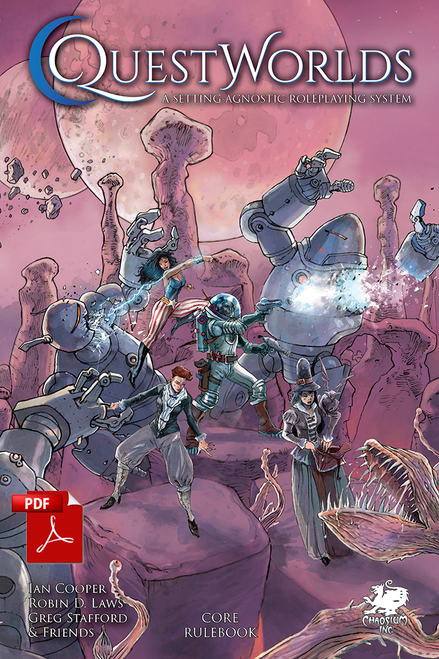
On paper, it’s Chaosium’s generic, ORC-licensed evolution of the old Hero Wars / HeroQuest engine: a D20-based, fiction-first framework for heroic, serial stories in pretty much any genre you care to bolt on. In practice, it feels more like a writers’ room whiteboard with dice attached. There’s a small, clean core mechanic, and then concentric rings of optional rules (sequences, communities, campaign structure) that you can peel back or stack on depending on how chewy you want things to be. As someone who wants a system I can tune for everything from mythic Rome to small-town folk horror, that immediately made me sit up and pay attention.
What kind of toolkit is QuestWorlds trying to be?
The book keeps circling three big ideas about play.
First, that stories are about obstacles and revelations. A “quest” is essentially an episode of genre TV: an inciting incident, a chain of challenges and clues, a climax, and some kind of fallout. Those then string into a “series” of half a dozen or so quests, possibly with a “final season” to tie everything off. That’s the default pacing frame, and the rules, examples, and GM advice are all angled toward that sort of arc.
Second, that player characters are meant to be protagonists, not fragile assets. They can absolutely lose, get hurt, and suffer setbacks. But they’re not supposed to spend three sessions bleeding out in a ditch. Death is something everyone at the table is meant to see coming and agree matters, not a random crit at level one.
Third, that the rules are there to support your creativity, not replace it. The text is full of “use what you like” notes, “only roll when failure is interesting,” and reminders that you’re supposed to be making rulings based on genre credibility rather than hunting for the One True Rule.
I like all of those principles. Where I occasionally bristle is when those suggestions harden into “this is what QuestWorlds is for.” It’s at its best when it remembers it’s an engine. It’s less charming when it sounds like it would really prefer me to run upbeat heroic fiction in neat twelve-episode chunks.
The good news is that, underneath the voice, the actual mechanics are almost entirely onion layers. The core is very small and very clean. Everything else you can treat as seasoning.
Characters: keywords, breakouts, and “if it matters, make it an ability”
QuestWorlds characters are built out of abilities, and the game is beautifully promiscuous about what counts as one. Skills, relationships, professions, reputations, bits of gear, personality traits, your signature stupid decision-making habit, if it matters in play, you can write it down and give it a number.
The backbone of a character is a set of keywords. These are broad packages like “Private Detective”, “Dwarf of the Chalk Hills”, or “RV Common Good Crew.” A keyword tells everyone roughly what your deal is and implies a whole raft of things you can plausibly attempt. If you’ve got “Temple Archivist”, we don’t need a specific “Read Old Manuscripts” skill; it’s baked in.
From each keyword you can spin off breakouts. These are narrower specialties that sit on top of the keyword and get a higher rating. If “Private Detective” is your keyword, “Surveillance” might be a breakout. That’s the game’s way of saying “yes, you can do lots of things, but you’re particularly good at this bit.”
Anything that doesn’t nest nicely under a keyword becomes a standalone ability. “Concealed Wicked Stiletto”, “Happy-Go-Lucky”, “Holds the Purse Strings”. These are all the sort of flags that make my GM heart sing, because they’re invitations. You’re telling the table “I want this to cause trouble, please poke it regularly.”
Personality traits and flaws live in the same space. A flaw like “Coward When Cornered” or “Trusts Authority Too Much” is both a mechanical handle and a story hook. The game explicitly rewards you for leaning into them: when a flaw costs you, it can generate experience, which is exactly the kind of bad life choice reinforcement loop I probably shouldn’t enjoy as much as I do.
Relationships and communities are abilities too. “Owes Favour to the Dockers’ Guild”, “Trusted by the Captain”, “Daughter of the Last Dragon”. These get written down, rated, and invoked like anything else. That makes it very natural to have entire scenes about obligations and social pressure, because those things are literally on your sheet rather than in some abstract “backstory” corner nobody looks at.
Crucially, the book pushes an as-you-go approach to character detail. Start with a concept and a handful of abilities that matter now. Let the rest emerge in play. If something is important, it either appears on the sheet as a new ability or shows up on camera in a scene. If it never shows up, maybe it never mattered. As someone who has watched too many lovingly written backstories wither in the face of actual play, I’m entirely on board with this.
Under the hood, every ability has a rating on a 1–20 scale. Once you go above 20, you wrap around into “masteries” (20 becomes 1M, 21–40 is 1M+X, and so on). Every five points is roughly a ten percent swing in your odds. It’s simple enough that you can eyeball what “12 vs 17” means without consulting a chart, which is all I really want at this tier.
Contests: one opposed roll to decide the moment
Everything important in QuestWorlds boils down to a contest: an opposed D20 where you set what’s at stake, roll once, and let the outcome drive the fiction.
First you frame the contest. You and the GM agree what the “prize” is and what stands in the way. “I want to get the goblin baby out of the burning building without a scratch” is a classic sort of statement. The rules keep prodding you to be clear and specific here, because everything downstream flows from that.
Then you set target numbers. Your target is your ability rating, plus or minus any augments from other abilities, situational bonuses or penalties, story-based benefits and consequences, and so on. The GM gives the opposition a resistance rating on the same scale. For most everyday obstacles, that resistance will sit in a band around 14 and the book gives you a little ladder of “easy, moderate, hard, nearly impossible” to anchor that.
You both roll. Any roll equal to or under your target is a success; anything above it is a failure. Certain special results, like rolling your target number exactly, count as “big” successes. Each side translates roll + masteries into a small pool of successes.
The interesting bit is what happens next. You compare successes. The difference (zero, one, two or more) maps onto a degree of victory or defeat. Coming out one degree ahead is a clean success. Two or more is a crushing win. Coming out one degree behind is a solid failure. Zero is that wonderful, chewy middle where you succeed but with a big problem, or fail but with a useful boon.
Finally, you narrate and mark any benefits or consequences. Those usually take the form of bonuses or penalties to later related rolls, in +/-5 chunks that wear off over time or with recovery scenes. A big win might give you “Confident 5” going into the next confrontation; a bruising failure might leave you with “Shaken 5” until you actually do something about it.
Once everyone has internalised the degrees table, contests move quickly. Roll, glance, announce: “Okay, that’s a marginal victory, you drag her out, but she’s inhaled a lot of smoke and the stairwell is now a write-off.” The math isn’t glamorous, but it doesn’t get in the way either, and I like that the same single roll covers everything from social showdowns to monster fights.
There are group contests for “everyone piles in” situations and special cases for multiple contestants chasing the same prize (elections, races, competitions), but the engine doesn’t change. You’re still converting D20s into a degree and then into story.
And when you don’t roll is as important as when you do. Assured contests are a formalised “just say yes” tool. If success is a foregone conclusion or failure wouldn’t be interesting, the GM just gives it to you. No dice, no drama. The book hammers this pretty hard, and it’s an attitude I wish more trad-adjacent systems made explicit.
Sequences: when one roll isn’t enough
Sometimes a single contest feels too thin. You want to see the tide turn, momentum shift, people get worn down. For those big tent-pole moments, QuestWorlds gives you sequences: multi-round conflicts where you chip away at some abstract track of how close you are to winning or losing.
The simplest is a basic scored sequence. Each side has a pool of resolution points. Every exchange you roll a contest and the degree of victory or defeat translates into points gained or lost. When someone runs out, the sequence ends. It’s an easy way to model duels, chases, arguments, or anything else where you want more than one swing without tracking hit locations or exact distances.
There are spicier variants. Wagered sequences let everyone bet resolution points at the start of a round. Go big and win, and you can clinch things fast. Go big and lose, and you crater yourself. There’s a further “desperation stake” option for all-in moments. It’s very on-brand for heroic gambits and big emotional pushes.
Then there are chained sequences. Here you string a series of smaller conflicts together, all contributing to a character’s larger “resolve” pool. Every defeat erodes that pool; hit zero and you’re out of the larger struggle. The classic example is a war or campaign: your character can win battles and still eventually be exhausted, broken, or sidelined by the sheer grind.
These systems are clever, and they do exactly what they’re meant to do. My inner minimalist, though, looks at scored vs wagered vs chained plus all the associated tables and quietly mutters, “this is at least one layer of onion too many for how I tend to run games.” The book does say you can ignore all of it and live off simple contests, and I think that’s important. Sequences are one of those subsystems I’d bring in sparingly, for genuinely pivotal scenes, and happily forget exists the rest of the time.
Story points: retakes and small miracles
Sitting on top of contests is the main meta-currency, story points. You gain them mostly when things go badly for you (defeats, bad consequences, complications) and you spend them when you want the story to bend a little.
You can use a story point to get a second chance at a contest, squeeze out extra successes, or blunt a nasty outcome in a sequence. The more interesting option, though, is the plot edit. For a point or three, you can declare a useful fact into being: the guard is an old friend, there’s a convenient storm rolling in, the vampire misjudged the time and dawn is closer than it looked.
The book offers examples and some light structure about what counts as a marginal vs minor vs major edit and how much those should cost. The important constraint is social: don’t break continuity, don’t steal other people’s spotlight, and don’t use it to weasel out of consequences that actually make the story better.
None of this is revolutionary if you’ve played Fate or Cortex or various PbtA hacks. But what I appreciate is that QuestWorlds doesn’t treat it as optional seasoning. Plot edits are baked into the core loop. The “For Players” chapter explicitly assumes you’ll occasionally use story points to reframe a scene rather than just eke out a win. That’s exactly the level of meta I enjoy. Enough to rescue a good idea from the dice once in a while, but not a constant shower of coupons.
Communities and campaigns: the outer ring of the onion
One of the nicest optional layers is the community system. If your series revolves around a particular group (a village, a starship crew, a criminal syndicate, a superhero team’s city) you can treat that community as a character with its own resources.
You give it broad ratings in things like Wealth, Morale, War, Technology, Magic, and so on. Those numbers represent how much oomph the community can bring to bear when you lean on it. In play, you might make a quick contest to persuade the council to spare some soldiers or open the vaults. Succeed, and you get a hefty bonus to your own roll in the ensuing action. Fail, and maybe your standing with the community suffers.
Each use depletes the resource, which is the important bit. If you keep calling in favours and reinforcements without doing anything to replenish those tracks, you’re steadily bleeding your home dry. The game gently nudges you toward doing quests that shore up community resources as well as your own personal story. It’s a simple, effective way to weave faction and place into the mechanical fabric of the campaign.
This layer feels genuinely optional in a good way. You can ignore it completely and run a perfectly fine series about roaming trouble-shooters. Or you can turn it on and suddenly you’re playing a show where the town or ship is as much a character as any PC. I find community focused games like Salvage Union or Out of the Ashes incredibly appealing so this is exactly the sort of plug-in I enjoy.
Genre, tone, and how bossy the book gets
The core rulebook is mostly system. It gestures at four small example genres (space traders, supers, flightwood fantasy, and czarpunk crime) to show how you might build keywords, abilities, and communities for different settings, but it doesn’t try to sell you one Big Default World.
What it does do is lean hard on a specific style of play. It talks a lot about “series structure,” about quests as episodes, about character arcs over six to twelve sessions. It assumes, unless you overrule it, that your protagonists are competent, resilient, and broadly on the side of good. Even injuries and defeats are framed as ways to drive growth rather than as potential endpoints.
If you want to run pulp adventure, superhero drama, or similar high-concept, high-emotion stuff, that’s all fine and sensible. Where I find myself making notes in the margin is when that tone bleeds into prescriptions. “The best way to run QuestWorlds is…” always makes me twitch, because my instinct with a generic engine is to start asking, “yes, but what if I want to do creeping horror? Or grubby low fantasy where people can die to a bad roll? Or a very slow, low-stakes drama about a village?”
To the designers’ credit, the actual rules don’t stop you. You can push resistance numbers up, treat certain contests as legitimately lethal, and ignore the seasonal framing if you want a looser campaign. You can absolutely run weirder, sadder, quieter stories. But you’re doing that by gently pushing against the stated “sweet spot” of the system rather than riding with it.
That’s the tension for me as a GM. QuestWorlds is billed as a toolkit. It largely functions as one. It occasionally sounds like a game that thinks it already knows what you should be doing with it.
Where it sits on my mental shelf: Fate, Cortex, Savage Worlds, and GURPS
On my internal map of engines I might reach for when I don’t want to build one from scratch, QuestWorlds shares a neighbourhood with Fate Core and Cortex Prime, and it waves across the street at Savage Worlds Adventure Edition (SWADE). It also sits diagonally across from things like GURPS, quietly sipping tea and trying not to make eye contact.
Fate and QuestWorlds both love freeform traits and meta-currencies. Fate gives you aspects on everything, stunts, a fairly prescriptive skill list, and a very clear structure around compels and invokes. QuestWorlds is looser. Abilities are whatever you write down. Resistance is mostly a GM judgement call. Story points are important but don’t entirely replace failure. If I wanted lots of crunchy little switches to flip and a huge ecosystem of existing hacks, I’d lean Fate. If I wanted something that feels more like a trad game with some storygame habits grafted on, QuestWorlds would be the pick.
Cortex Prime revolves around building dice pools out of traits and then parsing totals and effect dice. It’s a lovely tactile system for people who enjoy scooping a fistful of polyhedrals and doing small amounts of maths. QuestWorlds is the opposite end of that spectrum: one D20 each, then straight into narration. Cortex gives you fun in the build; QuestWorlds gives you speed and clarity.
SWADE lives in a different-but-adjacent space. Pulp-forward, minis-friendly, with cards and bennies and a strong “fast, furious, fun” ethos. I think it’s brilliant when you want tactical skirmishes, swingy explosions, and a fairly concrete sense of distance, ranges, and status effects. QuestWorlds doesn’t really care where people are standing on a grid. It cares what they’re trying to achieve and what it costs them emotionally and narratively. If you want chases, templates, and shaken/wounds, SWADE is probably the better pick. If you want a cleaner, more abstract engine for big character drama with the occasional cannon shot, QuestWorlds will feel more at home.
And then there’s GURPS. I’ve never actually played GURPS, which qualifies me perfectly to make sweeping generalisations about it on the internet. Culturally, it’s the poster child for universal, simulationist, point-buy everything. You can model almost anything if you’re willing to put the hours in, and the game tries very hard to treat the world as a place where physics and logistics matter. QuestWorlds frankly doesn’t care about that stuff. It doesn’t want to tell you how heavy your pack is. It wants to know which flaw will make you do something unwise at exactly the wrong moment. If you enjoy building characters like engineering projects and feel satisfaction when the rules model reality closely, QuestWorlds will feel hand-wavy. If you break out in hives at the words “3d6 roll under” and “detailed advantage list,” QuestWorlds may feel like the chilled, guitar-strumming cousin who lets you improvise the chords.
So who is QuestWorlds really for?
If you like running campaigns that feel like TV shows with a clear protagonists, recurring supporting cast, a sense of “this is the story of these people in this place”, QuestWorlds is right in that zone. It rewards players who lean into personality traits and relationships, who are happy to see their characters get knocked around emotionally and mechanically in exchange for good scenes.
It’s also for GMs, like me, who occassionally want a reliable engine rather than a pre-baked setting. If you’ve got your own worlds, or mash-ups, or half-formed ideas kicking around and you need something that can be persuaded to do superhero family drama one month and bronze-age myth the next, QuestWorlds is a solid candidate. The core D20 contest plus a light sprinkling of story points and optional community rules will take you a long way.
Where I think it shines least is at the extremes. If your joy is crunchy tactical play, precise build optimisation, and the satisfaction of having rules for every edge case, this is going to feel abstract. If your joy is fully GM-less, deeply experimental storygames, this is going to feel too trad and too GM-centric. It’s intentionally in the middle.
As for me, will I actually run it? I think yes, but in a very particular way. I’d strip it right down to the core contests, keep story points, keep flaws and relationships loud, and treat sequences and some of the more baroque options as things to add only if a campaign proves it needs them. I’d also happily ignore some of the book’s assumptions about tone when they don’t suit what I’m trying to do.
If that sounds like the sort of relationship you have with systems, i.e., take what works, cheerfully discard the rest, then QuestWorlds is a very usable, very thoughtful engine to have on your shelf. Just remember: it wants you to run a show. It can do other things, but it’s happiest when there’s a season recap at the end.
Leave a Reply