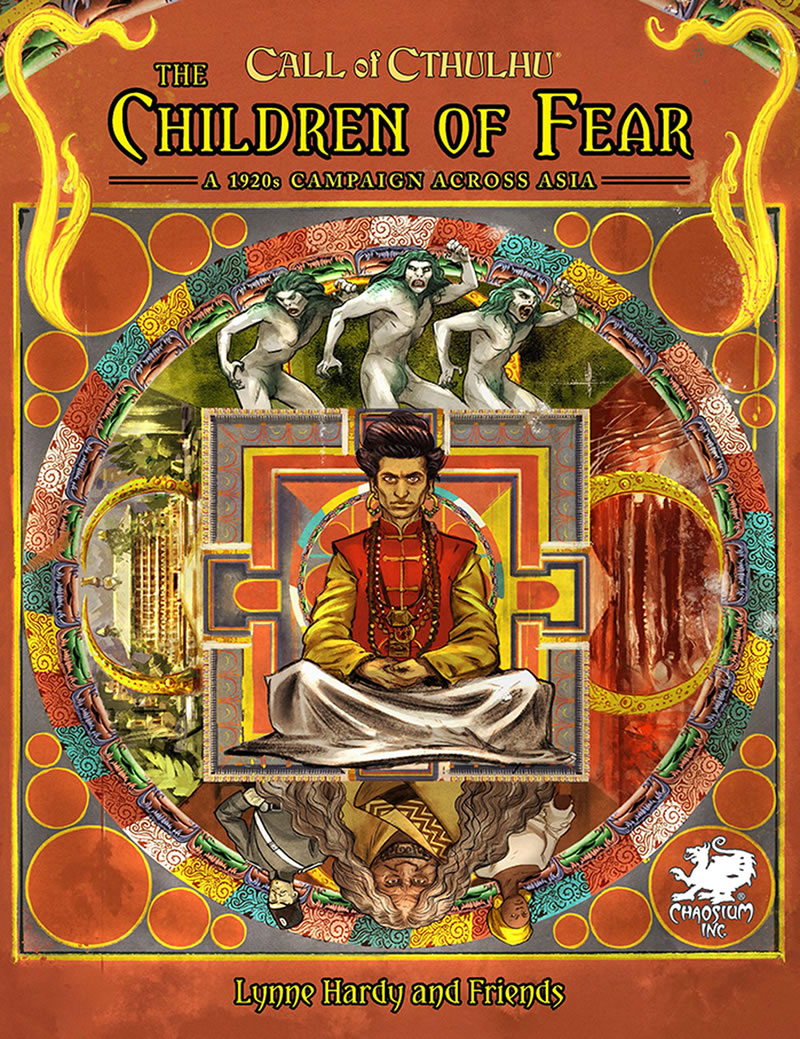
The story of Sian had begun like a nuisance, missing canes and porcelain pillows, rumours of little people and funerary coins, but it ended like a knife turning. Before the caravan ever rolled out of the western gate, the investigators learned what the city had really been doing. Testing their curiosity, baiting their conscience, and waiting until they were just invested enough to follow the thread into the earth.
22nd September 1923. An Jinqiang quietly separated himself from the rest of the party and went looking for answers the polite parts of Sian would never offer. He found them where the city’s vice pooled and hardened. The Den of the Sleeping Buddha, a place of smoke and low laughter where mahjong tiles snapped like insect shells and men watched one another more carefully than they watched the game. An sat down at a high-stakes table and played through the night, losing half his disposable income with the calm of someone buying something more valuable than money.
By dawn he had what he wanted. A line to Mr. Wen, the local gang boss, and the kind of wary respect that comes from paying your losses without flinching. An asked about the recent pilfering of sentimental items and the circulation of grave goods. Wen didn’t pretend ignorance. The underworld knew about it, the way rats know where the grain is stored. They were aware of Sai Na and his “cursed” activities, and they made it plain that stopping him would be considered a favour. Grave-robbery and bad omens have a way of bringing heat down on everyone nearby.
23rd September 1923. The next day, while the others moved through the daylight business of expeditions, meeting Mi Han, bargaining for porters and mappas, counting silver, An treated Sai Na like a target. He learned where the man kept his warehouse. He learned the shape of his habits. And, crucially, he learned how Sai Na vanished at night. Through a secret way in the western wall, slipping out toward the low mounds beyond the city, where tombs sat like veins under thin soil.
That night, An gathered Miriam, Aiko, and Lee in the lobby of Kulou House. Their attempts to wake Marcy failed. Whatever sleep had taken her, it held fast. An shared what he’d found and proposed what it demanded. They would watch Sai Na, follow him, and see where the trail ended.
Just after midnight they took positions outside the warehouse, close enough to read the rhythm of the street, far enough not to be obvious. When Sai Na finally emerged, moving with the careful confidence of someone who believes he is alone, Aiko became the shadow. She followed at a distance, light-footed and patient, leaving small signs along the route for the others to pick up, marks and pauses that turned the city into a kind of map only the investigators could read.
Sai Na wound through the Muslim Quarter, then toward a raised patch of cobbled ground near the western wall. For a moment he was lost from view, swallowed by the dark geometry of lanes and buttresses. But Aiko caught him again at the wall itself. From a distance the crack he used didn’t look like much, just a fault line in ancient stone. Up close it opened into something else entirely, a seam wide enough to admit a man without forcing him to crawl. Sai Na slipped through with practiced ease and vanished into the cold air beyond.
Aiko waited until she was sure the others had seen her, then followed him out into the shallow depressions west of the city. There, half-hidden and poorly covered, the entrance to a tomb lay exposed. A sandy canvas that might once have disguised it had been pulled aside, leaving a dank mouth in the earth. When the others arrived, all four investigators went in.
It was a cramped descent, awkward and close, and then the tomb opened into a series of small burial chambers whose walls had been disturbed. Broken statues of people and animals jutted from collapsed soil like bones. Everywhere there were signs of excavation: scraped earth, scattered fragments, the petty mess of someone working fast and without reverence.
What stopped them was the pile. Newer objects sat gathered in one place, as if arranged with care. The professor’s cane. The porcelain pillow. Mi Han’s silk cap. A small museum of recently stolen sentiment, assembled below ground like offerings. And around the pile, in a loose circle, stood nine familiar figures, naked, armless terracotta dolls, the same crude shapes that had haunted rumours and substitutions across the city.
For a moment the investigators simply looked at it. It had the clarity of a confession. Whatever had been happening in Sian wasn’t random pilfering. Someone was collecting emotional weight, gathering it where the dead could reach it, marking it with clay bodies and quiet intent.
An and Lee wanted to press on and find Sai Na, convinced the man must be deeper in the tomb. Miriam, however, couldn’t leave the stolen objects in that place. Aiko stayed near the entrance, partly to watch for danger, partly to watch Miriam. Miriam stepped toward the pile and reached for the professor’s cane. The moment her fingers closed around it, the tomb changed. The terracotta dolls came alive with a sudden, jerking purpose. They lunged. Miriam screamed, the sound swallowed and multiplied by stone. In the same instant a bout of madness seemed to flood her, amnesia like a wave breaking over a shoreline, pulling names and context out to sea. She staggered back, gripping the cane like a weapon, and then she was fighting.
The scene became frantic and brutal. Clay bodies snapped and scraped across the floor, too fast, too purposeful. Miriam swung the cane in wild fury, smashing terracotta heads and torsos into shards. Aiko lunged to wrestle the cane from her, thinking, perhaps, that returning it might satisfy the dolls, that the cane itself was the trigger and could be the offering. But Miriam, too far gone, dodged away. She bolted out of the burial chamber toward the exit, the dolls pursuing like a swarm.
The commotion drew An and Lee back. They took in the situation with the grim steadiness of people who have stopped being surprised and started being practical. Lee rushed to Miriam, staying close enough to keep her from running blind into danger. An moved with controlled violence, helping break the dolls apart as they came. Between Miriam’s frantic swings and An and Lee’s support, most of the dolls were shattered into useless pieces.
When the last of them fell, Lee stayed with Miriam until the fog began to lift and the woman’s eyes returned to herself. Then, with the immediate danger dealt with, An and Aiko went deeper into the tomb to find Sai Na.
They found him. Sai Na, confronted in the family tomb he’d been stripping, did not present as a mastermind. He was frightened, cornered, and painfully human. He told them it was his family’s tomb and he had fallen on hard times. He spoke of hunger and desperation, of choices made one shovel stroke at a time. An and Aiko didn’t mention the terracotta dolls, not yet, perhaps because saying it aloud would make it harder to keep the situation contained. Sai Na denied knowledge of the hotel thefts. He denied knowledge of sentimental objects being taken from foreigners. In his version of the story, he was a grave-robber, not a supernatural thief.
Aiko stood with a gun trained on him, the barrel steady, her face unreadable. For a long moment it felt as though she was weighing something colder than justice, whether ending Sai Na would be safer than letting him walk. In the end, An took the gun from her. The decision the investigators made was a kind of mercy but more so, it was control. Sai Na would make reparations. He would return what he had taken from the tomb. And the goods stolen from living people, wherever they had truly come from, would be returned wherever possible.
It was nearly dawn by the time they stumbled back to Kulou House, dirty and exhausted and carrying the kind of secret that makes a room feel unreal.
24th September 1923. In the morning they caught Professor Thaddaeus Johnson before he left the city and returned his cane, his actual cane, recovered from the tomb. His gratitude was immediate and genuine, the relief of a man given back something that mattered. They also caught up with Marcy, who was incredulous that she’d been left behind. The others insisted they had knocked, that there had been no answer. Marcy, mollified only slightly, finally shared what she’d experienced in the night. A presence in her room, an intrusion too light to be a man, and a terracotta doll left where something dear should have been. The theft pattern hadn’t ended. It had simply been unmasked. Restitution would have to come later.
With Mi Hu’s caravan assembled and the city’s wet lantern-light behind them, the expedition finally left Sian. The last of the gate-noise died in their ears, bells, mule-brays, shouted prices, the hiss of cart wheels on brick, until the city loosened its grip and the road ran west into the old artery of empire.
The caravan found its rhythm. Harness leather creaked. Dust gathered in hems and book seams and the corners of teeth. At dusk they reached the first government resthouse, thick-walled around a yard that promised safety and delivered noise. Cooks bellowing, travellers shouting for tea, animals stamping in the dark, fleas rising from old bedding in invisible armies. Heat sweated from kang beds warmed by hidden coals, and nobody slept deeply enough to call it rest.
The road, meanwhile, kept leaving messages. Names scratched into plaster. Regiments. Dates. Prayers. A joke here, a memorial there, a curse that looked fresh enough to sting. And on smoke-black walls, the Cyrillic script slanted downward as if written by a shaking hand. Over and over, in charcoal and sometimes in something darker that had seeped into stone like a wound: they are come.
Somewhere out in that long attrition of travel, Marcy had a vision again, sleep taking her all at once and dropping her beneath a fruit-heavy tree in furnace-hot air, snakes bright as wet lacquer moving through cracked roots. She heard clay knocking softly against clay below ground, like jars shifting in earth. A woman’s voice spoke just behind her ear, gentle and amused.
Dig carefully.
When Marcy turned, there was no one, only a mango hanging low enough to touch, green on one side and blackened on the other, as if fire had licked it and moved on. Then a hot wind struck her face full of dust and ashes, and she woke with the taste of sap at the back of her throat.
Weeks passed. Skills sharpened. Habits hardened into routine. The expedition learned to live inside discomfort.
Beyond Lanchou the world narrowed into the Kansu Corridor, rock and wind and the sense that all roads were being watched by older roads beneath them. The caravan threaded passes where the sky became a strip of tarnished silver overhead. Faces at the resthouses turned stranger, harder to place. Traders, drifters, refugees, old soldiers who kept one hand near a knife even while eating.
And still the same line waited, again and again, clinging to the route like a second kind of history:
They are come. The end is upon us. For they are come.
Then, after the long erosion of the road, the land opened once more. Tun-Huang lay ahead, half oasis, half threshold, and beyond it the valley of Ch’ien-fotung. The trail bent between trees whose branches whispered of cold still to come. Ravens watched from rock. The cliff face rose in tiers, dark apertures cut into soft stone by generations of hands now dust, hundreds of cave mouths staring outward, patient and empty as sockets.
There was little movement. A few birds. A faint snap of canvas somewhere above. The feeling that the place had been waiting for them for longer than any human should be asked to imagine.
Then, from one of the upper caves, a broad red-headed figure in a battered fedora appeared and started down a ladder toward the caravan with all the purpose of a man who had already decided what use he had for their arrival.
Leave a Reply