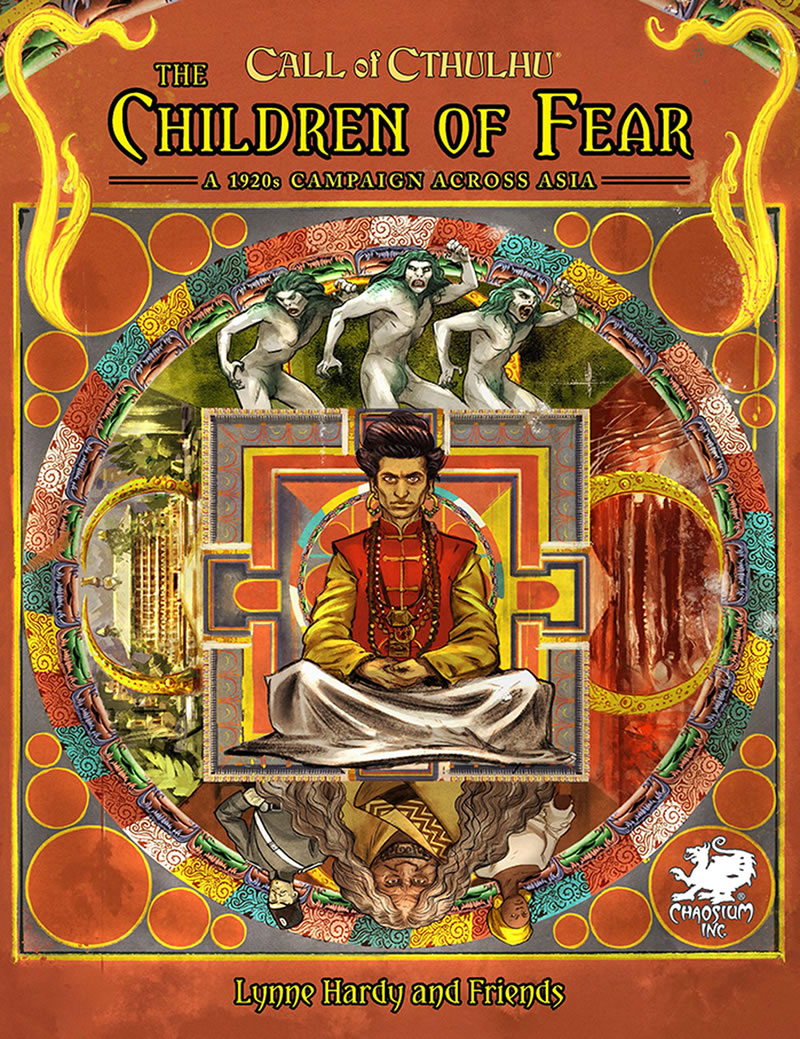
29th November 1923. After two months of road-dust, resthouse noise, and the steady attrition of distance, Tun-Huang arrived like a held breath finally released. The oasis felt half real, half mirage, green pushed up against rock and wind, until the caravan turned toward the valley of Ch’ien-fotung and the cliffs rose in tiers, dark apertures cut into soft stone by generations of hands. Hundreds of cave mouths stared outward, patient and empty as sockets. The place had the oppressive calm of something that had been waiting.
Langdon Warner met the investigators among those hollowed faces with the blunt relief of a man running on fumes. He was large, red-haired, moustached and goateed, his clothes good quality but battered by the prevailing conditions. His manner was abrupt, downright rude in the eyes of some, and he looked as if sleep had become a luxury he’d forgotten how to afford. He spoke quickly, eyes flicking toward ledges and shadowed cuttings as if expecting movement where there was none, then pushed straight past greetings and into the problem.
He suspected there was a secret cave. Rumour said Russian exile soldiers had found it. Warner had been turning that thought over for days, sleepless and increasingly raw with it, and now he had a group in front of him, people he could use. He wanted the Russian writings translated. He wanted anything that might be a direction, a confession, a warning.
That was where the expedition’s changing cast mattered, and it mattered immediately.
Aiko Tanaka stepped forward first. She had been learning Russian during the long road west, taught in spare moments by Demyan Babanin, the blond, sharp-eyed exile the expedition had hired back in Sian. Aiko didn’t make a show of it, she never did, but she offered Warner the one thing he clearly needed: practical help. Between her careful study and Demyan’s fluency, they could read whatever the Russians had left behind.
Warner’s relief was visible, almost indecent. He didn’t ask where Aiko had learned. He simply seized the possibility that his suspicions weren’t trapped inside his own head.
The other new arrivals folded into the work more quietly, but no less decisively.
Sofía Álvarez Calderón, a Spanish diplomat with a scholar’s eye and a traveller’s restraint, moved through Tun-Huang as if she were already taking notes for a future report no one else could read. Tailored coat, practical boots, camera slung ready. Warm manners paired with a habit of watching first and speaking second. She treated the caves with visible respect, as if sacred places were not simply historic sites but living contracts.
Qingling Wei, a young Chinese woman with cropped hair and the taut, streetwise alertness of someone who survives by noticing what others miss, seemed to treat Tun-Huang less as a wonder and more as a location with blind spots. She watched Warner, watched the cliff line, watched the movements of strangers the way a smuggler watches a dock.
Peter Long arrived with a different kind of hunger. He embodied the confident intellectual, argumentative, alive. The Silk Road was his subject and his obsession, and reaching Tun-Huang felt like stepping into the margins of a book he’d been reading all his life. Liberal thinker, historian, opinionated to the point of occasional trouble, Peter carried his politics with him the way others carried a knife, but he also carried an open mind that made him valuable in places where certainty gets people killed.
With introductions barely finished, Warner led them to the cave where the Russians had stayed. It wasn’t a single “Russian cave” so much as a cluster of chambers where the frescoes had been broken and wide patches of wall scraped bare down to plain rock. Across those bare sections, Cyrillic graffiti crawled like ivy. Warner insisted the walls held directions. He wanted translation, decoding, the kind of cleverness that could turn scrawled insults into a map.
The investigators checked the claim the only way that matters in places like this. By reading it, slowly, properly. Most of the graffiti was what soldiers always leave behind when they suspect history won’t care. Names and regiments, crude jokes, comments about officers and women and places that meant nothing to anyone outside that vanished unit. And yet one phrase kept recurring with unnerving insistence, appearing again and again like a refrain that had outlived its singers:
They are come. The end is upon us. For they are come.
Lee, however, refused to accept that the writing was meaningless simply because it wasn’t polite. She treated the graffiti as pattern rather than prose, repeating fragments, placement, rhythm across walls, and began to piece together something larger hidden in the scatter. When she finally spoke, it was with the flat certainty of someone who has found the seam:
Between the Red God in his dark heaven
And the fat merchant’s camel
The Door to Paradise
The clue made the paintings matter. Across the cave, the investigators began matching Lee’s phrase to the murals. One showed a red Buddha standing on a broken human corpse, surrounded by fierce female figures, wild, dynamic, charged with a kind of sacred violence. A few feet away, on the far side of an empty, unpainted alcove, was another. A caravan led by a fat man dressed in fine silks being accosted by bandits. At the rear of the procession a truculent camel turned its head as if it wanted to go home.
Peter had peeled away earlier to bury himself in the library cave, but he rejoined them now with a word that snapped the imagery into place. He’d been reading about dakinis, khandromas in Tibetan, figures that are not merely spirits but liminal beings. Messengers, guides, teachers, tricksters, sometimes protectors, sometimes obstacles. Wisdom dakinis and worldly dakinis, moving between realms to do what needs doing. The red Buddha and the fierce women around him weren’t decorative. They were a signpost in a language older than Warner’s impatience.
Warner stared at the blank alcove with hungry certainty. The “Door to Paradise,” he suggested, wasn’t metaphorical. The alcove, strangely unpainted beside such vivid imagery, looked like something had been plastered over. A sealed passage. A hidden seam.
He wanted to return at night with tools, quietly, without drawing attention.
Sofía, scanning the cliff face and the scattered figures moving between caves, noticed someone watching them from afar. An elderly man, small and bent but bright-eyed, dressed in traditional robes. Warner’s expression tightened when he followed her gaze. The watcher matched the descriptions of the caves’ self-appointed guardian, Wang Yuanlu, the Taoist caretaker whose devotion to restoration was entangled with a history of bargaining, secrecy, and foreign interest.
They withdrew for the evening with the careful restraint of people who had learned that daylight belonged to eyes and questions.
After night fell, they returned with lanterns and tools, moving with the controlled quiet of thieves in a place built to resist theft. With one decisive effort they broke through the plaster of the blank alcove and found a stone door behind it. When they opened it, the air that seeped out was unusually fresh, as if the room had been sealed and yet somehow remained… tended.
In torchlight, the investigators saw piles of books and banners, oddly-shaped implements, and numerous statues casting distorted shadows up walls that were surprisingly bare. They were not the first people to enter in recent times, several items had clearly been moved. Peter assessed the chamber with a historian’s instinct and suggested the manuscripts here might be as old as, or older than, those Aurel Stein had removed, implying the cave had been sealed before the 11th century.
It was the kind of discovery that could redraw scholarly maps. It could also redraw political ones. But they couldn’t properly assess anything without better lighting, and even Warner could be forced into restraint when the dark was this thick and the cliff this unstable. Reluctantly, he called it for the night.
When the others returned to the accommodation cave, their little pocket of shelter where packs and lamps and boots could be dropped without ceremony, Aiko slipped away without announcement and went back to the graffiti cave alone. Perhaps it was the same careful instinct that had kept her alive since Sian. If there was a door in the cliff that had been sealed for centuries and opened again in secret, then someone should be there to see who came looking for it.
The night did not reward that caution with calm.
A tremor ran through the rock. In the graffiti cave the ground shivered under Aiko’s feet, and loose stone broke free above. She barely had time to look up before rock fell and struck her, pain sharp and immediate, the kind that leaves you suddenly aware of how thin the margin is between “ancient site” and “collapse.” She endured it, bruised and rattled but still standing. Her mind took her back to the Great Earthquake that had destroyed Tokyo just two months back. If she wept, noone was there to hear her.
Back in the accommodation cave, Qinling was woken later by Sofía’s dream. It wasn’t a quiet waking. Sofía came up from sleep with the wrong kind of breath in her chest, shaken and pale as if her mind had been dragged somewhere it didn’t have the right to visit. Qinling didn’t ask for a full explanation before moving, she simply sat with her, steady and present, the way someone does when they’ve learned that fear is easier to survive when it isn’t faced alone.
Sofía described what she’d seen. The graffiti cave stripped bare of every mural except the warning smeared in blood-red in her own language, They are come. The end is upon us. For they are come, the letters shifting position when she tried to focus on them, nausea rising like a tide. Then the earth shaking. A huge black bird flying up into her face, striking at her eyes with beak and claws. When she fought it off, it exploded into a deluge of pink and white petals, peach blossoms, briefly forming the shape of a seated figure before dissolving into a pool of blood that seeped away through a crack in the floor.
After that, the night settled again, uneventful only in the sense that nothing else announced itself so clearly. The cliff, however, had already made its point.
30th November 1923. In the morning, as the investigators emerged from the accommodation cave into damp air and pale light, an anxious elderly man waited for them in traditional long-sleeved robes. He introduced himself as Wang Yuanlu, the Abbot of Ch’ien-fotung. He had been away collecting donations in nearby oasis towns and had returned with news of the tremor. Tremors, he warned, sometimes caused cave-ins and rock falls. He was deeply concerned for the well-being of his new guests.
Warner appeared shortly after, looking as though he’d had a bad night too, and could barely disguise his displeasure at seeing Wang. The caretaker’s concern slid quickly into interrogation. Who were these new arrivals, why were they here, and what did they intend to take?
Sofía stepped in again, smoothing the conversation with diplomat’s instinct before it could harden into accusation. She acknowledged Wang’s duty, treated his fears as reasonable rather than inconvenient, and framed the expedition’s presence as scholarly and careful rather than acquisitive. Wang remained uneasy, but his suspicion eased enough to permit them to remain, reluctantly, watchfully.
With that fragile permission in place, the investigators returned to the graffiti cave, opened the stone door they had uncovered, and slipped back into the secret chamber.
They had found the Door to Paradise.
Now they needed to learn what it truly opened onto, and what, exactly, had been shifting items in the darkness long before they arrived.
Leave a Reply