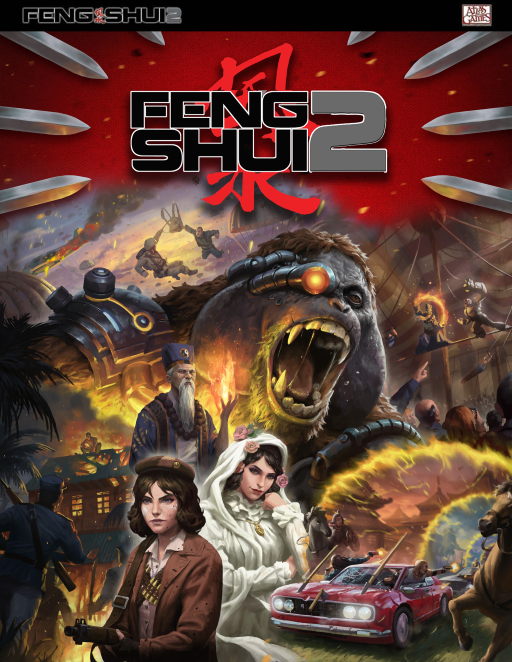
One of the quiet joys of this hobby is reading a game and immediately hearing a soundtrack in your head. With Feng Shui 2, the soundtrack in my head is an aggressively 90s mixtape. Gunshots as percussion, a lot of yelling in Cantonese, someone sliding down a banister while firing two pistols, and at least one villain laughing on a rooftop in the rain.
It’s also one of those games that has lived in my peripheral vision for years. I knew the reputation: “the Hong Kong action movie RPG,” “the one that invented mooks,” the Robin D. Laws classic. When Atlas brought out Feng Shui 2, I picked it up, admired the cover, and like any responsible adult, placed it carefully onto the ever-growing pile of games I definitely will run one day, once I’ve cracked time management and possibly cloning.
Now I have actually prepped it for a one-shot at a London one-day con, which felt like a good excuse to finally dig in properly. Feng Shui 2 isn’t just an “action movie RPG”; it’s a very specific snapshot of a cultural moment. The era of VHS bootlegs, Chow Yun-Fat and Jackie Chan, heroic bloodshed and wire-fu, when Hong Kong cinema quietly rewired how action worked on screen. The foreword is practically a love letter to trawling grimy video shops for the next mind-blowing fight scene.
So the question I’m trying to answer here is: what does this game actually feel like in 2026, when our reference points are as much John Wick and Marvel as Hard Boiled and Once Upon a Time in China? And for someone like me, who reads more rulebooks than action-movie Letterboxd lists, what does it look like to get this to the table for a con one-shot?
The Big Picture: Chi War, Junctures and Feng Shui
Feng Shui 2 is an action-fantasy game about hyper-competent heroes caught in the “Chi War,” a time-spanning struggle to control the world’s luck and destiny via mystical feng shui sites. Control enough of these sites and you rewrite history. Lose them and your faction’s version of reality gets overwritten by someone else’s.
The default campaign frame has you playing “Dragons”, a loose band of heroic trouble-makers taking on various factions in a sort-of-secret war fought across four “junctures” (time periods) plus the Netherworld between them:
- a mythic past full of kung fu, eunuchs and sorcerers
- a turbulent 19th-century juncture
- contemporary Hong Kong
- a grim cyberpunk future full of apes with guns and cyber-terrorists
Characters can come from any of these junctures. So yes, your party can be a Scrappy Kid from 90s Hong Kong, a time-displaced Old Master, a cyborg from the future, and a magical exorcist cop, all shooting at genetically uplifted gorillas in a burning casino built on a feng shui nexus under a shopping mall.
It’s a very specific flavour of gonzo. Action first, sense later. Where Outgunned (which I’ll get to one day) is “Die Hard and friends,” Feng Shui 2 is “every Hong Kong action film and half the anime shelf blended with time travel and Chinese metaphysics.”
Rules: Dice, Shots, and Schticks
Mechanically, Feng Shui 2 is crunchy in the way a 90s design lovingly polished for modern readers can be. Once you internalise the core loop, it’s surprisingly slick, but there is a loop.
The Core Roll: The Swerve
Everything rests on the Swerve: you roll two six-sided dice of different colours, one “plus”, one “minus”, and subtract minus from plus. That gives you a Swerve, which can be positive, negative, or zero. Add that to your Action Value (AV) in the relevant skill to get your Action Result. Compare that to the Difficulty (for tasks) or an opponent’s Defense (for attacks). Beat it and you succeed. The margin is your Outcome, which often turns into extra damage or a sense of just how gloriously you pulled it off.
Sixes explode. Roll a 6, roll again, keep adding. Both dice show 6 (boxcars)? Something remarkable happens, either spectacular triumph or catastrophic pratfall, depending on whether you still beat the target or not.
There’s also the gloriously named Way-Awful Failure for moments where fate decides to dunk your hero head-first into humiliation. A negative Action Result, or failing after boxcars, gives the GM license to bring in gun jams, sorcerous backlash, or other cinematic disasters.
You’ve got a Fortune pool (or Chi / Magic / Genome, depending on your type) you can spend to add extra Fortune dice to a roll, bumping your odds when something really matters. The same pool also powers your special abilities, so there’s a tension between “do something flashy” and “make sure I don’t fall off the burning truck.”
Action Values, Damage and Not Dying (Yet)
Characters have a handful of key stats. Main attack AVs (usually Martial Arts, Guns or Sorcery), Defense, Toughness, Fortune and Speed.
Combat boils down to roll Swerve + Attack AV vs the target’s Defense. If you hit, your Outcome + weapon’s Damage gives you Smackdown. The target subtracts Toughness from Smackdown and adds the remainder as Wound Points.
Hit certain thresholds on your Wound Points track and you start taking Impairment penalties, rolling Up Checks to see if you stay conscious in the middle of the fight, and eventually Death Checks once things get serious enough.
The game distinguishes between:
- Named characters: PCs, bosses, important supporting cast with full stats and Wound tracks.
- Mooks: faceless goons who go down in one decent hit.
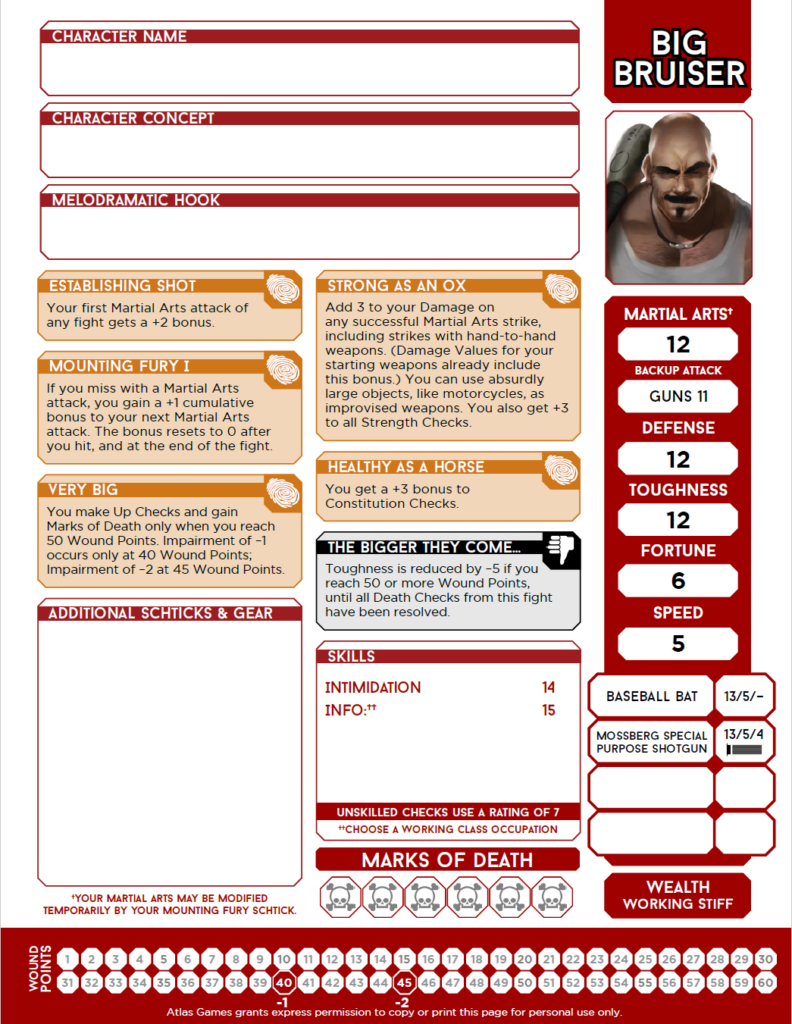
Mooks are deliberately simple. If you beat 13 with your attack, you take one out. Some abilities let you mow down crowds at once. This keeps the “hero vs 20 guys” vibe without drowning you in bookkeeping.
Sequences, Shots and the Countdown
Where the system really shines is in how it handles turn order and pacing. Each fight is broken into sequences, and each sequence is broken down into shots on a countdown from a starting number.
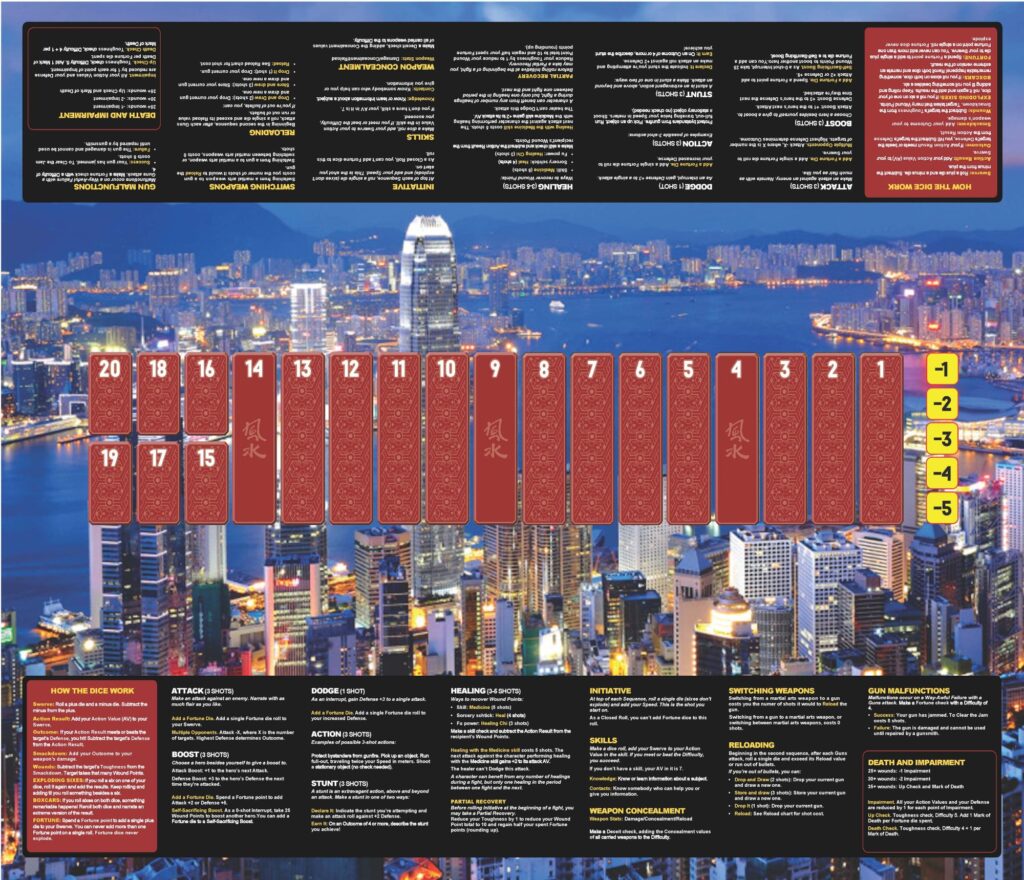
At the start of a sequence:
- Everyone rolls Initiative (1d6 + Speed). The highest result is the starting shot.
- You put everyone’s token on their starting shot number on a central shot track.
When the shot countdown hits your number, you act. Most actions cost 3 shots: take your action, subtract 3 from your current shot, move your token to that new number. Big or special actions can cost more, defensive stunts might cost 1 shot as an interrupt, and so on.
It’s a clever way to model the ebb and flow of screen time. Fast characters act more often. Big signature moves zoom in and eat more time. The price is that you, the GM, are managing a little mini-game of counters, tokens and arithmetic while also narrating a fight in which somebody is probably driving a truck through a wall.
The book leans into that with a printable shot counter and lots of practical advice. Pre-rolling mook attacks, telling players enemy Defense values to save time, allowing retroactive Dodges if you’re moving quickly and forget to ask.
Archetypes and Schticks
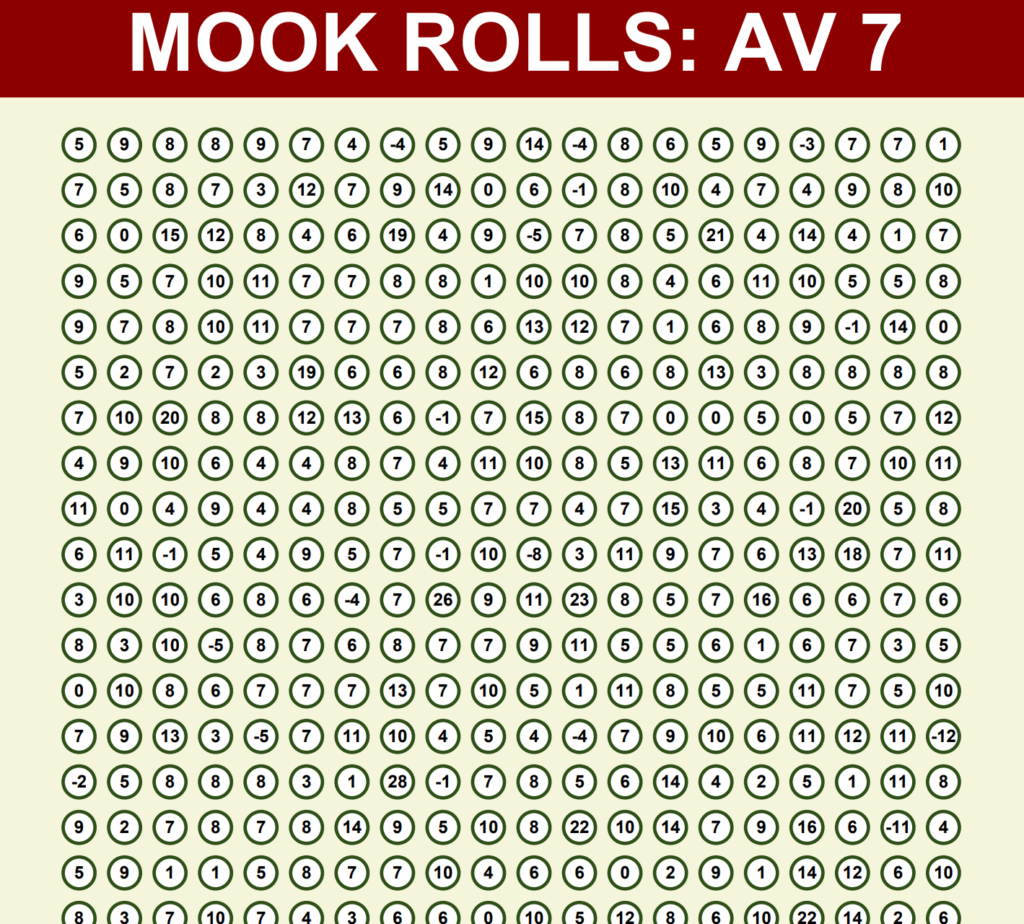
Character creation is gloriously fast by design. You don’t build from points. You pick an archetype (Big Bruiser, Maverick Cop, Sorcerer, Scrappy Kid, Ninja, Old Master, Cyborg, Transformed Dragon, Two-Fisted Archaeologist… there are a lot) and customise around the edges. Each archetype gives you your stats, a handful of signature “schticks” (special abilities or powers), and a short advancement section telling you what you’re likely to grow into.
Then you:
- Add a concept and name.
- Write a “Melodramatic Hook”. This is the personal emotional wound or obsession that gets you into trouble (lost love, family loyalty, thirst for vengeance, etc.).
- Do small cosmetic swaps of skills or gear if desired.
Schticks are where the flavour lands. Martial artists get Fu Paths that let them deflect bullets, unleash tiger strikes or become terrifying drunk boxing specialists. Sorcerers trade in backlash-ridden magic. Cyborgs pick up scroungetech implants. Gun bunnies do gun-bunny things. All of them are structured to directly interface with the core mechanics: bonus damage, extra shots, improved defenses, extra stunts against certain foes.
It’s much less “build optimisation puzzle” and much more “grab an action figure off the rack and start smashing it into other people’s toys,” which is exactly what it should be.
The Setting: Time-Hopping Action Pulp
Underneath all the big fights is a surprisingly flexible setting skeleton. The Chi War is essentially an excuse for you to mash genres together while still feeling “on brand.” Control of feng shui sites lets factions reshape history, triggering “critical shifts” that overwrite future junctures while leaving the past mostly intact.
That gives you some nice levers:
- Need to explain why your future is different? Someone lost a feng shui site.
- Want an excuse for “exiles” who don’t belong in any current timeline and feel slightly unmoored from reality? The book has that too.
- Want a whole campaign about trying (and failing) to prevent a shift? Easy.
But crucially, Feng Shui 2 never becomes a lore slog. This isn’t a giant metaplot that expects you to memorise factions and timelines like a university course. It’s more like a buffet of factions, each with enough hooks to riff off, but nothing you’re obliged to treat as canonically sacred. The Netherworld works as your hub, secret base and weird liminal place where different eras touch, and from there you hop into whatever flavour of action movie your table likes that week.
How I Expect It to Play at the Table
Since I’m prepping this for a one-shot, my perspective is very much “what is it like to teach and run this for strangers in four hours?” rather than “we played a 12-session Chi War epic.”
The strengths are obvious:
- Strong archetypal characters. Players can grab “Old Master,” “Maverick Cop” or “Transformed Dragon” and instantly know how to play them. No one spends 45 minutes agonising over feat choices.
- Mechanics that reward description. The rules explicitly encourage you to narrate wild stunts and then resolve them as normal attacks, possibly with modest bonuses. You don’t have to dig for obscure modifiers.
- A built-in emotional engine. Melodramatic Hooks give me free story ammo when I need to push a scene harder or justify why a character is suddenly overextending themselves.
The challenges are equally clear:
- The “Swerve + AV – Defense = Outcome = Damage” loop is simple, but it’s still more maths than modern ultra-light systems. Some players will love the tactile crunch, others will glaze over halfway through their first Up Check.
- The shot counter is brilliant but does need physical setup and a GM willing to herd tokens and remember who’s done what. Feng Shui 2 gives excellent tips on speeding that up: pre-rolling mooks, being generous with retcons, letting players roll defense instead of you rolling attacks, but it’s still more overhead than something like Outgunned.
- The game really wants players to lean into cinematic description. If your group prefers “I attack. I roll. I attack again,” you’ll get results, but it won’t feel like an actual Hong Kong action romp.
My expectation is that once everyone’s done a round or two of combat, the rhythm will click, and the rest of the session will feel like a rolling series of set pieces stitched together by banter, melodrama and the occasional plot.
Versus Outgunned (Briefly)
I’ve not reviewed Outgunned yet, so I’ll keep this short and let you click through for the full rant when I get to it.
Both games want to emulate action films, but they come at it from different angles.
Outgunned is a modern, rules-medium cinematic system built around pools of d6s where you’re chasing sets (two/three/four of a kind) rather than high totals. It wraps that in meta-resources like Adrenaline and Spotlights, a “Death Roulette” that tracks how close you are to a heroic demise, and a strong emphasis on scene framing, shared authorship and genre emulation for specific sub-genres (heists, spy stuff, horror, pulp adventures, etc.).
Feng Shui 2, by contrast, is more traditional in structure. One GM, clear separation of player and GM authority, fixed character stats, and a focus on moment-to-moment action resolution rather than meta-currencies and flashback mechanics. It’s also rooted very specifically in Hong Kong heroic bloodshed and martial arts cinema, with the time-travel Chi War giving you an excuse to throw in cyber-monkeys and sorcerers without breaking the tone.
If you want that shot-counter, beat-by-beat fight pacing, where who acts when and for how many shots matters; if you like pre-built archetypes and schticks and don’t particularly want to kitbash your own stunt economy; if you want a campaign frame that’s more than some missions strung together… then Feng Shui 2 is your game.
And if you prefer lighter rules with more narrative tools for planning heists, playing through montages and flashing back to “Of course, I planted the explosives earlier”… then Outgunned is the one.
Personally, with both books on the desk, Feng Shui 2 feels like the one I reach for when I want fights to be the star of the show and I’m happy to pay a bit more cognitive tax to get those crunchy crescendos. Outgunned is what I’d pick for a looser, more director-driven action movie one-shot where the structure of the mission matters as much as the shootouts.
Prepping Feng Shui 2 for a Convention One-Shot
By the time I sat down to write this, I had already prepped my London one-day con game: Lanterns of the Turning Year, a three-act contemporary-juncture one-shot about a Lotus geomancer trying to freeze the joy of Hong Kong’s Spring Lantern Festival at the exact instant the year turns. It was exactly the sort of premise I wanted for a first run of Feng Shui 2. Emotionally legible, visually loud, and structured around three escalating fights that could each teach a different bit of the system. It gives me a lion dance opener on the waterfront, a harbour fight with lantern boats and smugglers, and a rooftop climax at Ocean Park with a giant Lantern Engine and a villain who has decided the best way to protect people from heartbreak is to arrest time itself. Which is the sort of terrible idea that Feng Shui 2 absolutely thrives on.
Prepping it taught me something very useful about the game. Feng Shui 2 looks intimidating if you read it as a complete simulation of Hong Kong action cinema. It gets much friendlier when you treat it as a machine for delivering three or four excellent set-pieces with enough connective tissue to keep the emotional logic intact. So I built the scenario backwards from the fights. The lion-dance beatdown is there to teach initiative, shot costs, mooks, and a featured foe in a crowded, colourful environment where everyone would immediately understand the tone. The Lantern Fleet showdown at the harbour lets me widen the frame with movement, unstable terrain, boats, a floating restaurant, and the first obvious supernatural weirdness. The Lantern Engine finale gives me a boss fight with environmental toys, moral stakes, and enough vertical nonsense that somebody would almost certainly swing on a lantern string and kick a sorcerer in the head. A con slot only gives you a few hours, so that kind of structural clarity is essential.
I also leaned hard into something the scenario itself makes very easy. Tying the melodrama to joy and change rather than treating it as a separate layer pasted onto the action. Before play, I plan to ask each player one simple question about their Melodramatic Hook: what memory of joy would they fight to protect from being stolen or forgotten? That gives me immediate fuel for the villain’s bargains in the final fight and means the climactic speeches would connect back to something human rather than just “because you are evil and I oppose that in principle.” It is one thing to stop a ritual because the city is in danger. It is another to stop it because the villain is trying to erase the one fireworks memory you still have of your dead sister. That is the sort of nonsense Feng Shui 2 understands at a deep level.
For a first convention run, I made a conscious decision not to overcomplicate the rules teaching. I prepped the game so the first scene would start in motion, with the heroes already at the festival and the trouble kicking off almost immediately. I’m not going to explain the whole system up front. I am going to teach it by rhythm. Here is initiative, here is your shot cost, here is how you attack, and yes, you may absolutely dive off the stage through a string of lanterns if you tell me how it looks on camera. The opening fight is there to get everyone over the hump of the Swerve roll and shot countdown before the bigger, stranger material arrived. That’s general con advice as much as it is Feng Shui advice. Front-load the fun, teach only what is needed for the next ten minutes, and trust people to learn by doing rather than by surviving a fifteen-minute rules sermon.
On the practical side, I’ve printed a large physical shot counter and rules reference playmat, enemy stats and mook attack sheets that will let me run the fights fast without drowning in numbers. For Feng Shui 2, the shot counter is not decorative. It is the heart monitor of the fight. If the whole table can see it, the rhythm of the sequence makes intuitive sense much faster. I’ve also kept the foe roster disciplined. Mooks with clear visual identities, featured foes who each did one memorable thing well, and a boss whose gimmick is legible from the moment he starts talking. That feels right for a convention game. Nobody comes to a four-hour slot hoping the GM will unveil seventeen bespoke schticks and a spreadsheet.
Who Feng Shui 2 Is (and Isn’t) For
Feng Shui 2 is for you if the idea of action-centric sessions where most of the emotional beats happen mid-fight makes you smile. If you like crunchy but fast-moving combat systems, enjoy tracking who acts on what shot, and have players who will absolutely narrate their hero running up a stream of bullets to kick a cyborg in the face, this thing is a delight.
It’s especially attractive if you want a campaign frame that’s more than “we do some missions” but less than “you must digest 300 pages of metaplot.” The Chi War gives you stakes and context without demanding homework. You can run it as an ongoing studio-style series (“this week we’re in the future, next week it’s 1850s pirates”) or as occasional one-shots when you fancy something loud, colourful and slightly daft.
Given my own tastes, I can see Feng Shui 2 earning a place as an occasional special rather than a regular weekly. My brain tends to drift toward mythic weirdness, folk horror and melancholy fantasy. In that ecosystem, Feng Shui 2 is the high-energy palate cleanser where everyone gets to be absurdly competent, throw people through windows and resolve feelings with slow-motion doves and exploding scenery. I’m genuinely looking forward to running it at the con partly because it’s so different from my default mode.
On the flip side, this is not the game for you if you hate doing even mild arithmetic at the table, or know your group does. There are ways to smooth it, but the Swerve/Outcome/Smackdown loop and shot countdown are baked into the experience.
Also, if your table strongly prefers narrative/GM-lite games where mechanics mostly sit in the background and players share framing duties in a big way. Feng Shui 2 wants a decisive GM, a physical centre to the table, and a lot of on-the-fly adjudication of stunts.
Finally, the specific tone (Hong Kong action, heroic melodrama, time-spanning pulp nonsense) doesn’t do much for you then you can give this one a skip. If your action diet is more The Raid and Sicario than Once Upon a Time in China and A Better Tomorrow, the heightened chi-war mythology may feel more silly than stylish.
For the readers of my blog, then, if you enjoyed my posts on games that really commit to their aesthetic and are happy to learn a slightly fiddly but rewarding combat engine to get that feeling at the table, Feng Shui 2 is worth your time.
If the thought of printing a giant shot tracker and cheerfully announcing “you run up the bullets” makes you roll your eyes rather than grin, you can probably let this one pass and spend your evening reading something with fewer exploding doves.
Addendum: Further Reading for Actually Running the Thing
One of the best companions to Feng Shui 2 prep I found was Justin Alexander’s run of articles on The Alexandrian. He’s got a whole cluster of Feng Shui pieces there, including practical material on mooks, mission objectives, player advice, and encounter flow.
The handiest of the lot, especially if you’re prepping a one-shot or convention game, is his Feng Shui 2 System Cheat Sheet. It’s exactly the sort of thing I wish more games had in the book by default. A clean, usable breakdown of the core procedures that helps the system click faster at the table.
If you’ve read this review and thought, I’d like someone to help me get from stylish admiration to actually running the thing, that set of articles is well worth your time.

Leave a Reply